Felix Manalo (The Messenger from the East)
Felix Manalo, a poor Filipino who spent seventeen years searching through every Christian denomination for truth, experienced a three-day revelation in 1913 that led him to believe he was the prophesied “angel from the east” of Revelation 7:2—the final messenger to seal God’s servants before the great tribulation. When his newly founded Iglesia ni Cristo was officially registered on July 27, 1914, the exact same day World War I erupted in Europe, he saw divine confirmation that the biblical prophecies about war and a messenger from “the ends of the earth” (the Philippines, the farthest east from Israel) had converged in him. Despite persecution under Japanese occupation during World War II, Manalo’s conviction that he was God’s last-day messenger never wavered, and his movement grew into one of the Philippines’ largest homegrown Christian churches, claiming millions of members who believe the prophecies were fulfilled in their founder.
The questions began with gunfire.
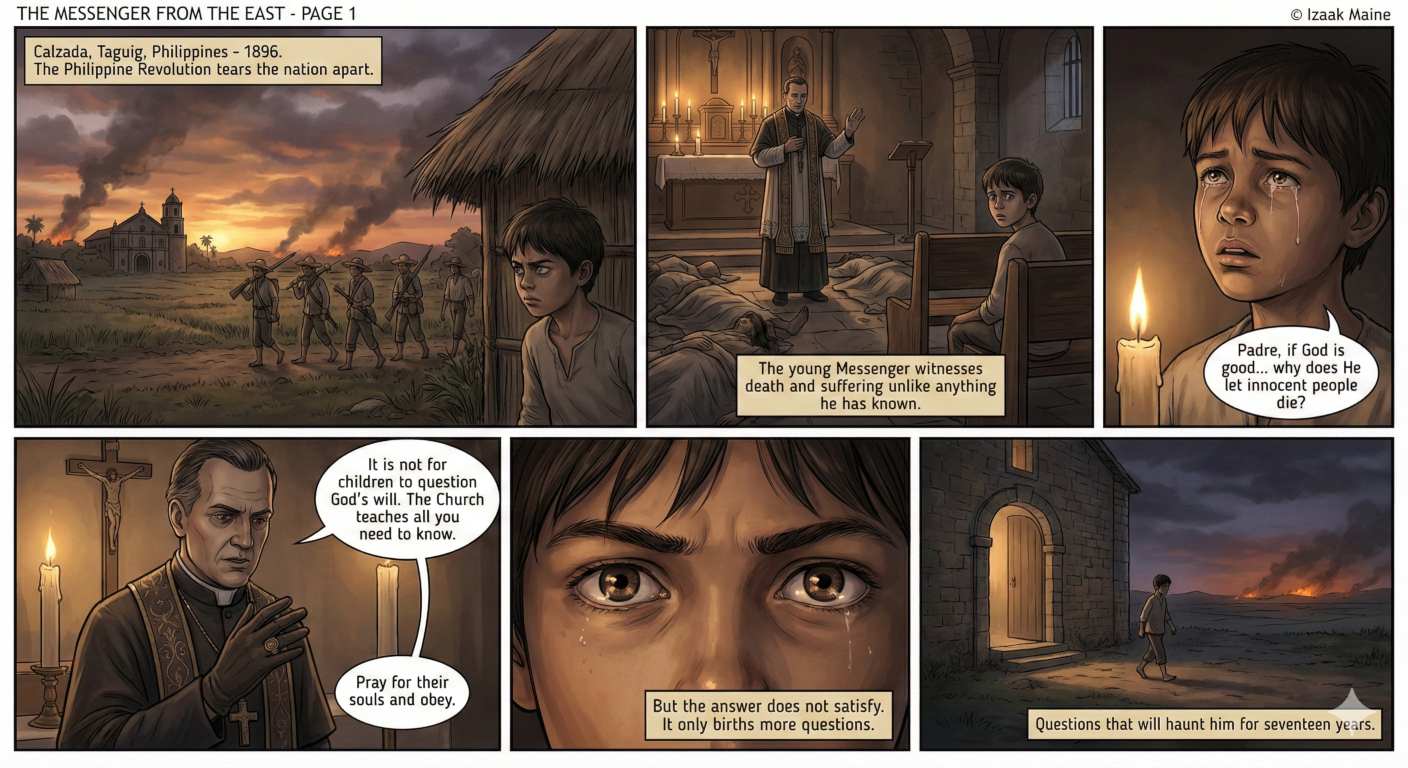
In 1896, ten-year-old Felix Manalo crouched behind his family’s nipa hut in Calzada, Taguig, watching smoke rise from neighboring villages as the Philippine Revolution convulsed around him. Spanish soldiers and Filipino revolutionaries were locked in a brutal conflict that would claim hundreds of thousands of lives, and young Felix—barefoot, poorly educated, born into rural poverty—couldn’t reconcile what he saw with what the Spanish priests told him about God’s love and divine justice.
“Padre, if God is good, why does He let innocent people die?” he asked the village priest after watching bodies blessed in candlelit ceremonies.
The priest’s answer was curt, dismissive: “It is not for children to question God’s will. The Church teaches all you need to know. Pray and obey.”
But Felix Manalo would spend the next seventeen years doing anything but obeying. What followed was a spiritual odyssey through virtually every Christian denomination available in the tumultuous Philippines of the early twentieth century—a journey that would culminate in three days of isolation, revelation, and the founding of what would become the Philippines’ largest homegrown Christian movement: Iglesia ni Cristo, the Church of Christ.
This is the story of how one man’s crisis of faith became a religious movement that would eventually claim millions of members worldwide. It’s a story of colonialism and independence, of prophecy and politics, of a man who believed he heard God’s voice in a rented room in 1913 and spent the rest of his life trying to prove it—even when Japanese bayonets were at his door.
The Wanderer
Felix Manalo was born on May 10, 1886, into a Philippines defined by suffering and transition. The son of desperately poor parents in what was then a backwater of the Spanish Empire, he received almost no formal education. Yet from early childhood, he possessed something that formal schooling cannot provide: an insatiable hunger for answers.
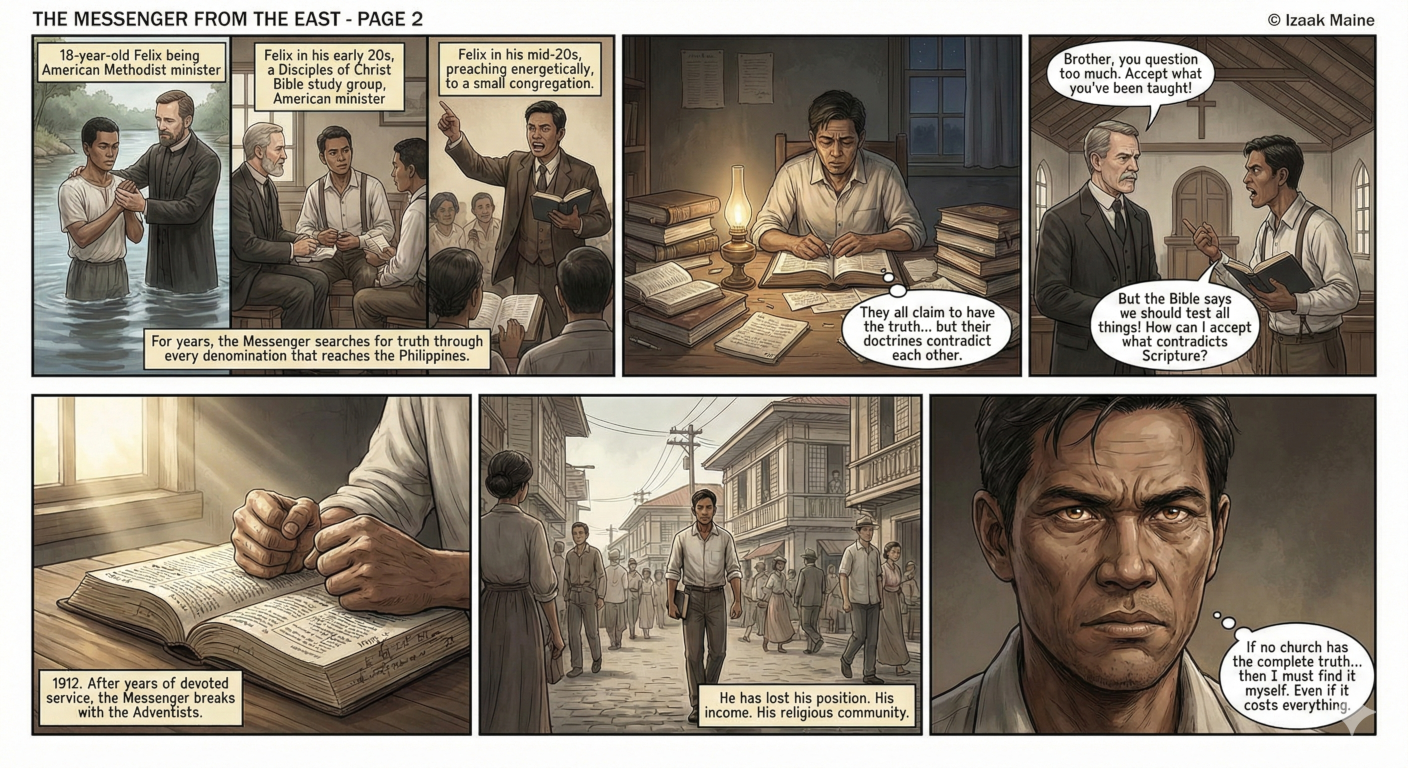
The Philippine Revolution shattered whatever faith he had in Catholic orthodoxy. As American forces replaced Spanish colonial rule in 1898, Protestant missionaries flooded into the newly acquired territory, bringing with them a buffet of competing Christian theologies. For young Felix, each denomination promised the truth. Each claimed divine authority. And each, he came to believe, fell short.
In 1904, at eighteen, he converted to Methodism. The baptism gave him hope—briefly. Within a few years, he had moved on to the Disciples of Christ. Then, in 1911, he found what seemed like his spiritual home: the Seventh-day Adventist Church. Here, finally, was a tradition that took biblical prophecy seriously, that studied Scripture with the intensity Felix craved.
He became a lay preacher, respected and effective. He should have been satisfied.
He wasn’t.
Late at night, hunched over a simple wooden table covered with Bibles in multiple translations—Spanish, English, Greek, Hebrew—Felix found himself wrestling with contradictions. The denominations he had explored all claimed biblical authority, yet their doctrines clashed fundamentally. They couldn’t all be right. Which meant most—perhaps all—were wrong.
“How can I accept what contradicts Scripture?” he challenged his Adventist church leader in 1912, his voice rising in frustration. The Bible commanded believers to “test all things,” yet questioning was treated as heresy.
The confrontation ended his relationship with the Adventists. At twenty-six, Felix Manalo walked away from his religious position, his income, his community—everything except his Bible. He was alone. And he was determined to find the truth if it killed him.
Three Days in Pasay
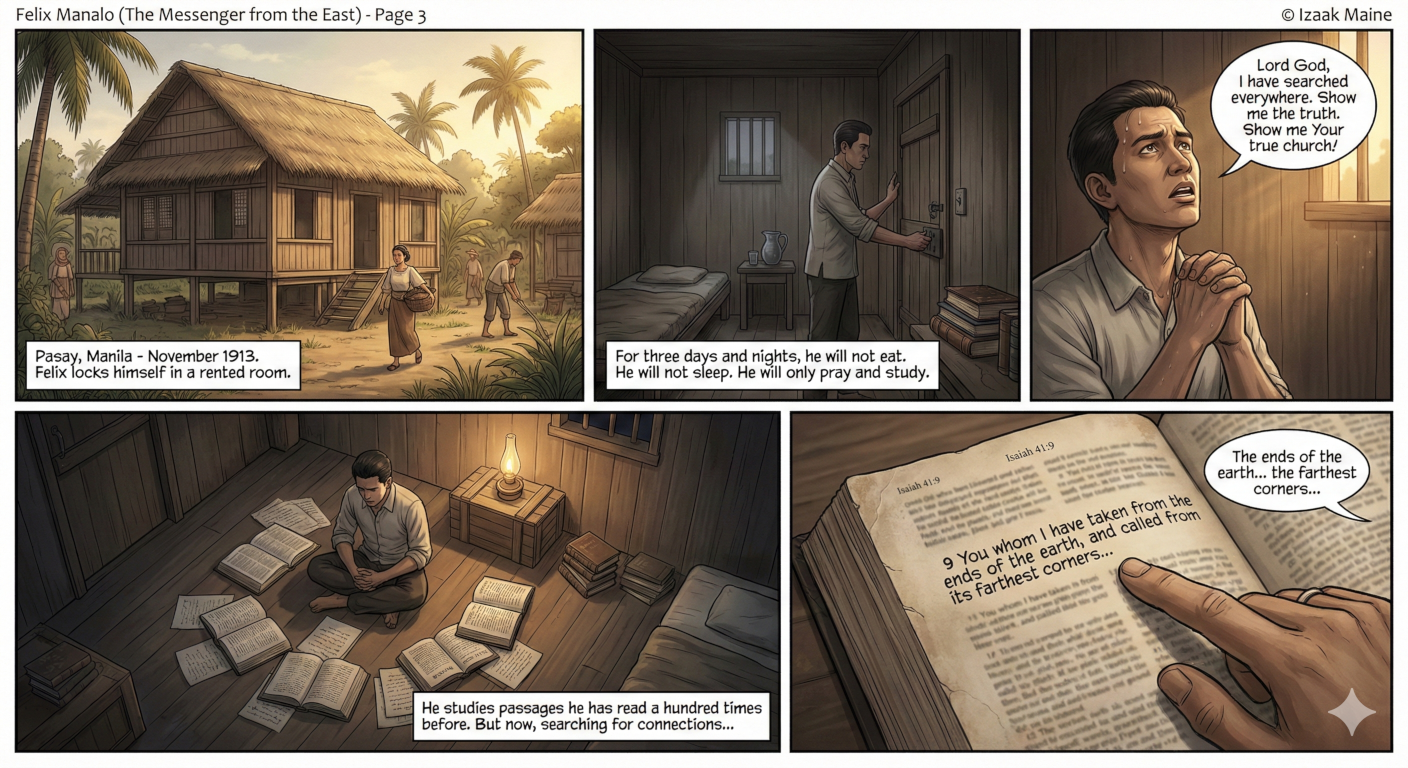
November 1913. Felix rented a modest room in Pasay, on the outskirts of Manila. What happened next would become the founding mythology of Iglesia ni Cristo, recounted to millions of members across generations. Whether one interprets it as divine revelation or psychological breakthrough, the historical fact remains: Felix Manalo locked himself in that room for three days and three nights with nothing but water, Bibles, and religious texts.
He would not eat. He would not sleep. He would only pray and study.
The first day brought desperate supplication. On his knees, sweat soaking through his simple clothes in the tropical heat, Felix begged for clarity. “Lord God, I have searched everywhere. Show me the truth. Show me Your true church!”
The second day brought feverish study. Spread around him in the lamplight were Bibles opened to passages he had read hundreds of times before. But now, exhausted and spiritually raw, he began seeing connections he had never noticed. Isaiah 41:9 leaped out at him: “You whom I have taken from the ends of the earth, and called from its farthest corners…”
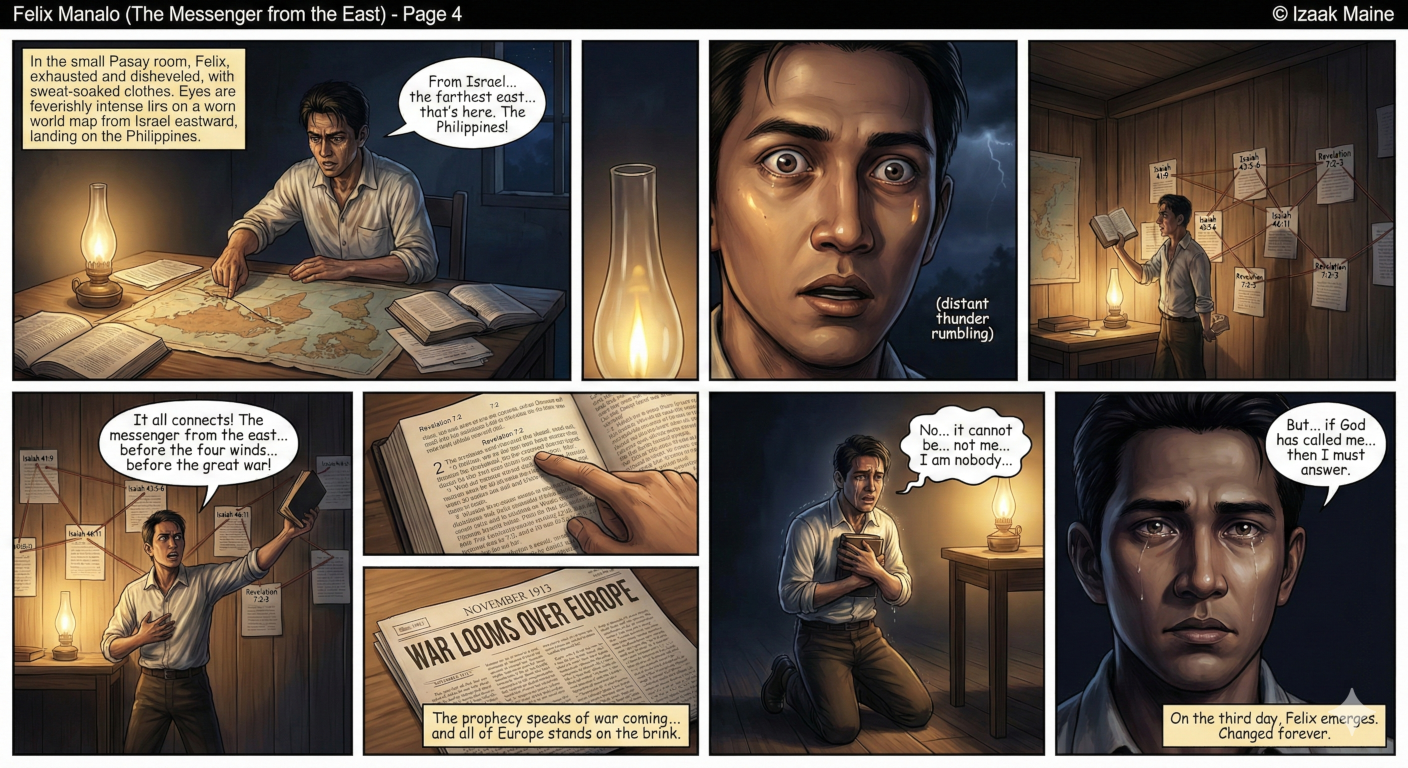
His hands trembling, he pulled out a world map. From Israel—the biblical center—where was the farthest east? His finger traced across Asia. The Philippines. The very edge of the known world. The ends of the earth.
The pieces began falling into place with terrifying speed. Isaiah 43:5-6 spoke of God’s children being gathered “from the east… from the west.” Revelation 7:2 described “another angel ascending from the east, having the seal of the living God.” This angel would appear before a great tribulation to “seal the servants of God.”
On the table beside his Bible lay newspapers. Headlines screamed about European tensions, military buildups, the powder keg ready to explode into what would become World War I. The “four winds” of Revelation—the coming war.
On the third day, as dawn broke, Felix Manalo collapsed to his knees, trembling. Tears streamed down his face as the full weight of what he believed God was showing him crashed over him like a wave.
“No,” he whispered. “It cannot be. Not me. I am nobody.”
But the conviction would not release him. If the prophecies were true—if a messenger was to come from the east before the great war—then someone had to answer that calling. And Felix Manalo, against every instinct of humility and self-preservation, believed that someone was him.
He emerged from that room a different man. The seeker had become the messenger.
The First Baptisms
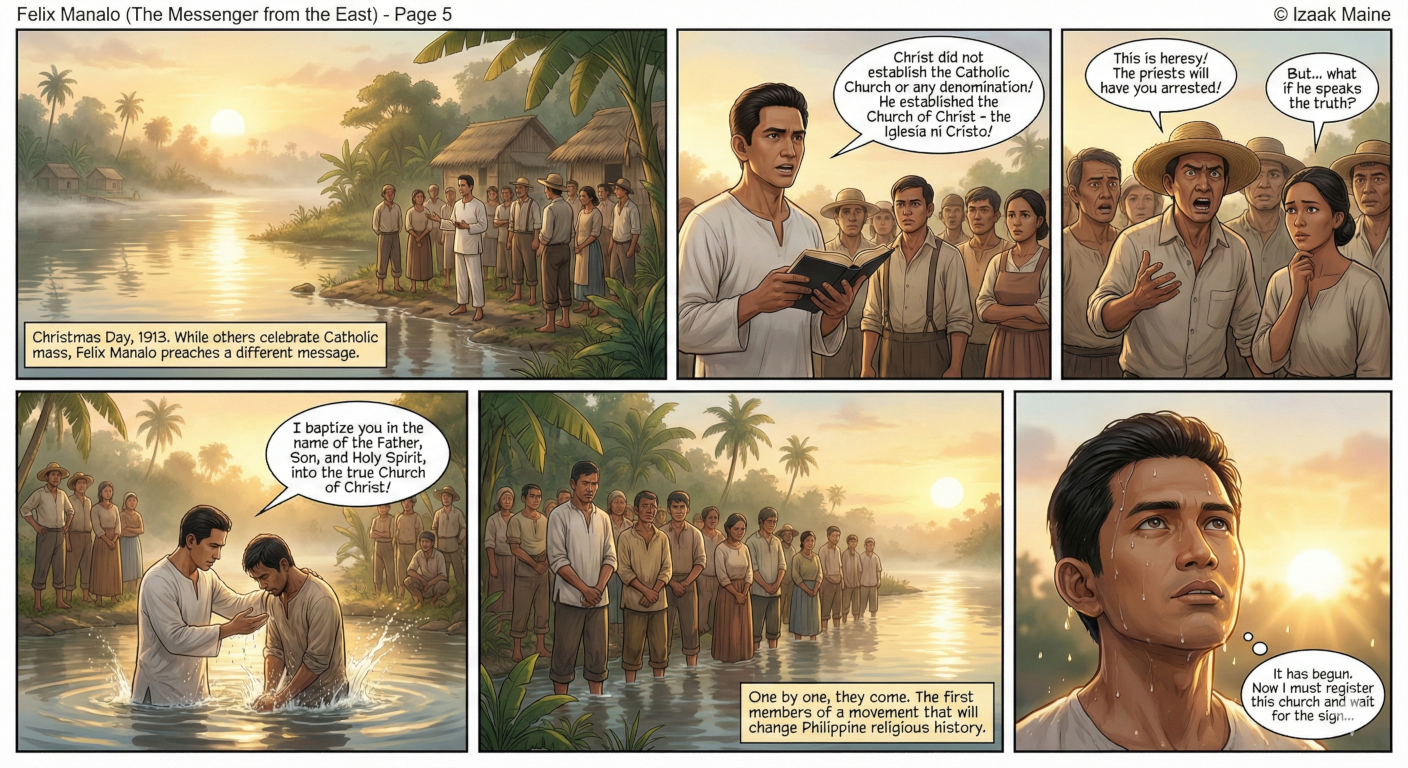
December 25, 1913. While Catholic Manila celebrated Christmas Mass, Felix Manalo stood on the banks of the Pasig River addressing a small crowd of curious onlookers—farmers, laborers, the poor and marginalized who had nothing to lose by listening to a new prophet.
“Christ did not establish the Catholic Church or any denomination!” His voice carried across the water. “He established the Church of Christ—the Iglesia ni Cristo!”
It was heresy, plain and simple. The Spanish may have left, but Catholic dominance remained entrenched in Filipino culture. Men in the crowd shifted nervously. “The priests will have you arrested!” one shouted.
But others listened. A poor farmer stepped forward. “I want to be baptized.”
One by one, they came. Felix, waist-deep in the river, baptized them “into the true Church of Christ.” The morning sun caught the water droplets as they fell, creating momentary rainbows. It must have felt, to those first converts, like witnessing the birth of something epochal.
They had no idea how right they were.
July 27, 1914
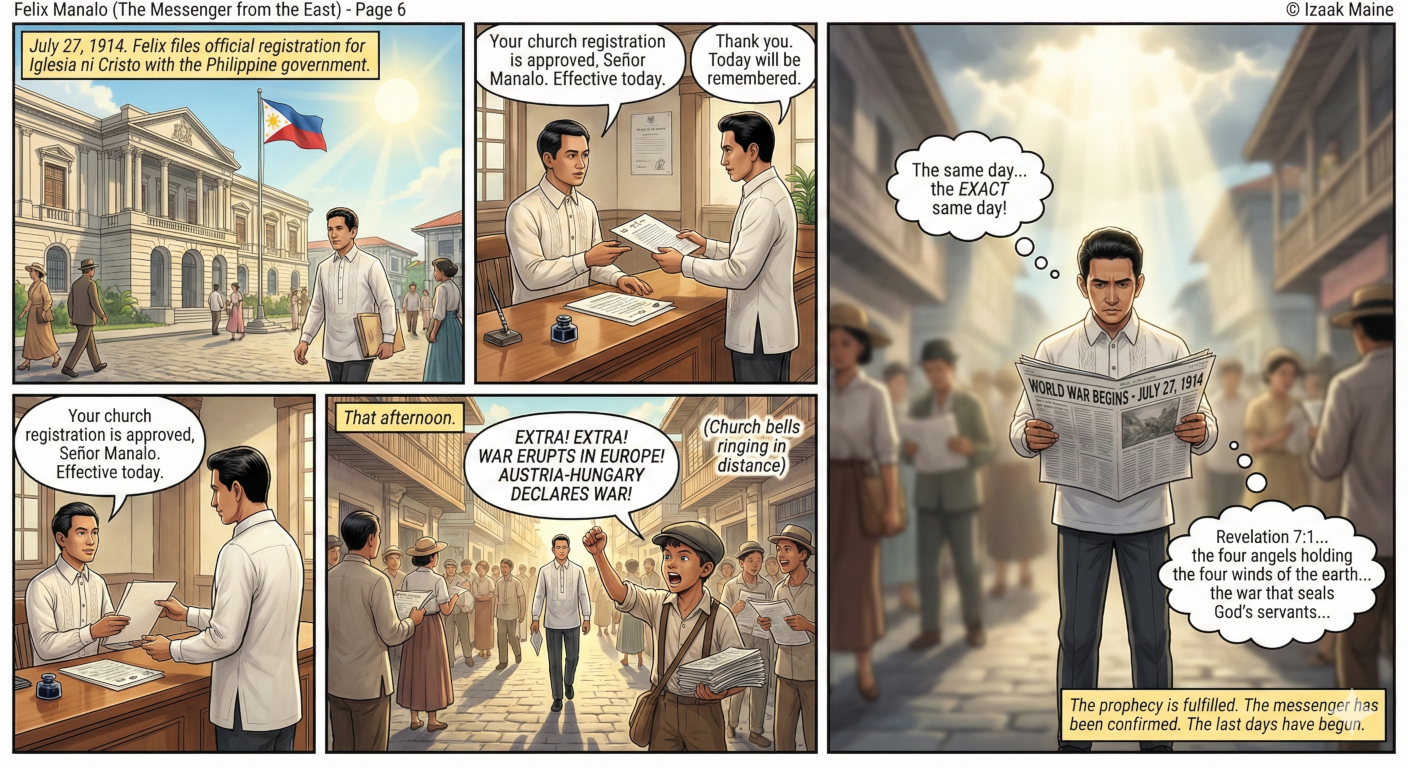
Felix moved quickly to legitimize his movement. On the morning of July 27, 1914, he walked into a government office in Manila and filed official registration papers for Iglesia ni Cristo. The Filipino clerk stamped the documents without ceremony. “Your church registration is approved, Señor Manalo. Effective today.”
Felix walked out into the humid afternoon, his church now legally recognized. He should have felt triumph. Instead, he felt expectation—as if waiting for a sign that had not yet come.
It came that very afternoon.
“EXTRA! EXTRA!” A newspaper boy’s voice cut through the street noise. “WAR ERUPTS IN EUROPE! AUSTRIA-HUNGARY DECLARES WAR!”
Felix froze. His hands shook as he grabbed a newspaper. The headline was impossible, providential, terrifying: “WORLD WAR BEGINS—JULY 27, 1914.”
The same day. The exact same day his church was registered.
The crowd bustled around him, but Felix stood motionless in the street, newspaper trembling in his grip. Revelation 7:1 spoke of four angels “holding the four winds of the earth” while God’s servants were sealed. The four winds—the war that would engulf the world. And it had begun the precise day his church became official.
For Felix Manalo, it was more than coincidence. It was divine confirmation. The prophecy was fulfilled. The messenger had been authenticated. The last days had begun.
Whether one believes in divine providence or remarkable chance, that synchronicity would fuel the conviction of millions of Iglesia ni Cristo members for the next century. Felix Manalo never doubted again.
The Messenger Revealed
For eight years, Felix built his movement quietly. He preached in simple chapels to growing congregations of Filipinos hungry for a faith that felt authentically theirs—not Spanish, not American, but rooted in biblical prophecy with the Philippines at its center.
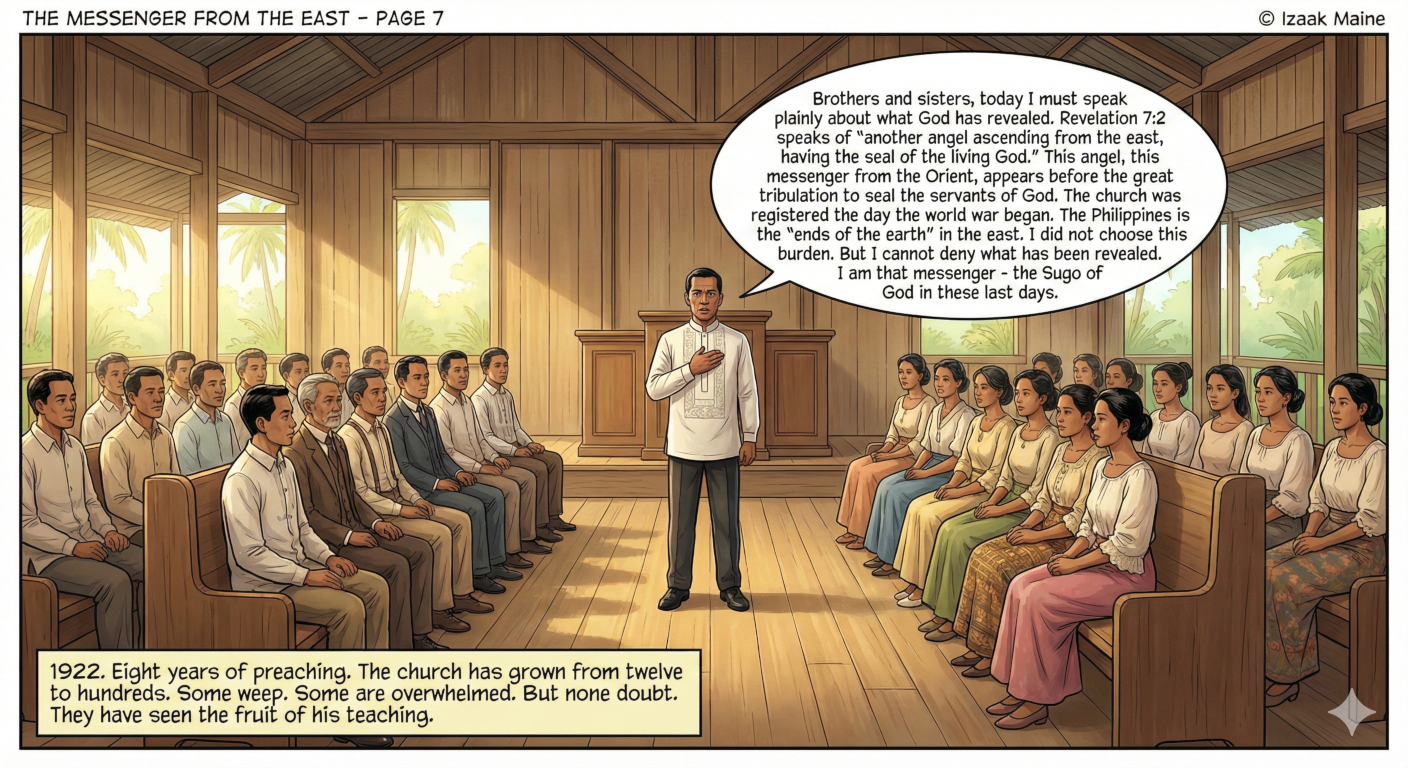
In 1922, the church had grown from twelve members to hundreds. Felix decided it was time to speak plainly about his role.
On a sweltering Sunday morning, he stood before his congregation and opened his Bible to Revelation 7:2. The chapel was silent except for the rhythmic whir of hand fans fighting the tropical heat.
“This passage speaks of ‘another angel ascending from the east, having the seal of the living God,’” he said, his voice steady. “This messenger appears before the great tribulation to seal God’s servants. The church was registered the day the world war began. The Philippines is the ’ends of the earth’ in the east.”
He paused, meeting the eyes of his congregation. Some already understood where he was going. Others waited, breathless.
“I did not choose this burden,” Felix continued, his hand on his heart. “But I cannot deny what has been revealed. I am that messenger—the Sugo of God in these last days.”
Some wept. Some sat in stunned silence. But the moment marked a theological Rubicon. Felix Manalo had openly claimed prophetic status—the last messenger before the end times. It was a claim that would define Iglesia ni Cristo’s identity and separate it irrevocably from all other Christian denominations.
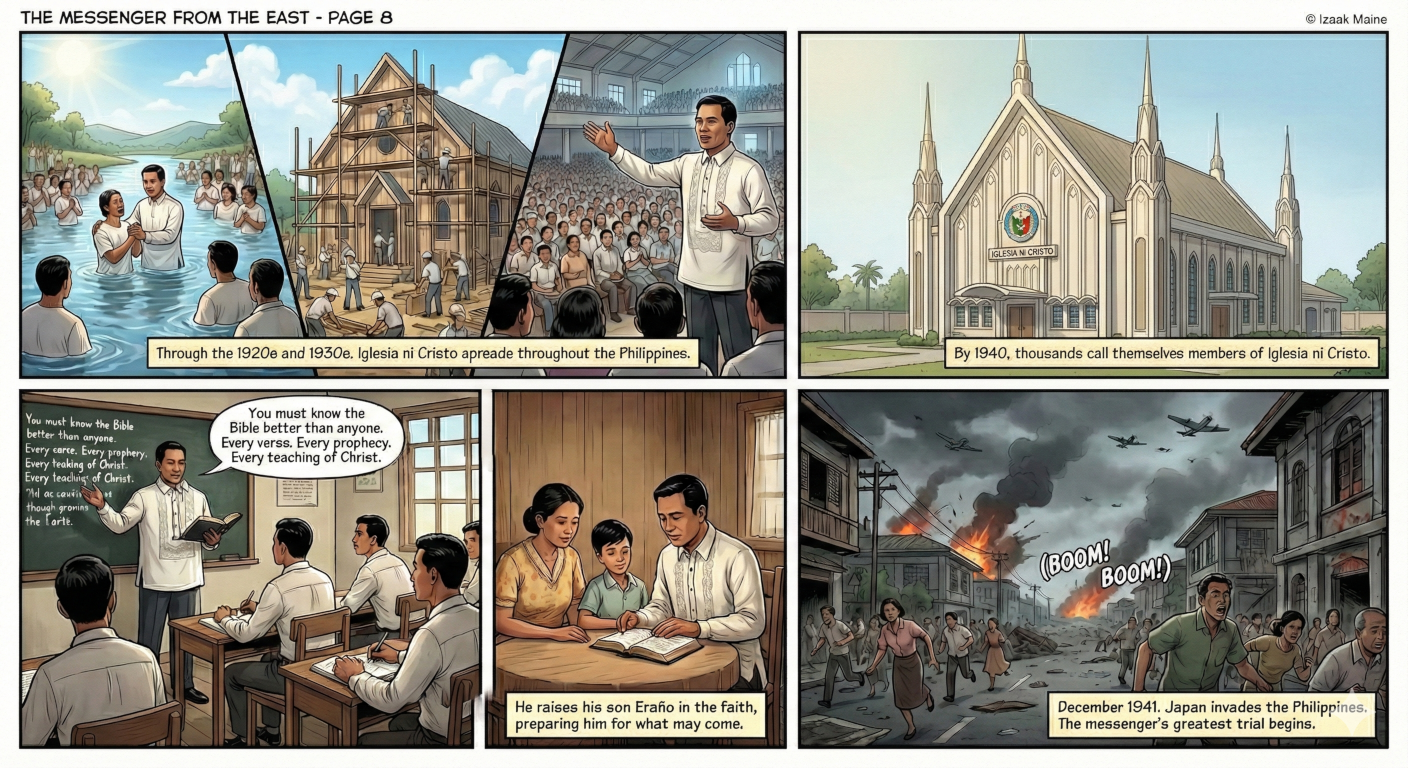
For the next two decades, the movement grew steadily. Felix trained ministers, established doctrines, built chapels across the archipelago. He raised his son, Eraño Manalo, in the faith, perhaps already sensing that leadership would need to pass to the next generation.
By 1940, thousands called themselves members of Iglesia ni Cristo. The messenger’s work seemed secure.
Then came December 1941.
The Trial of Fire
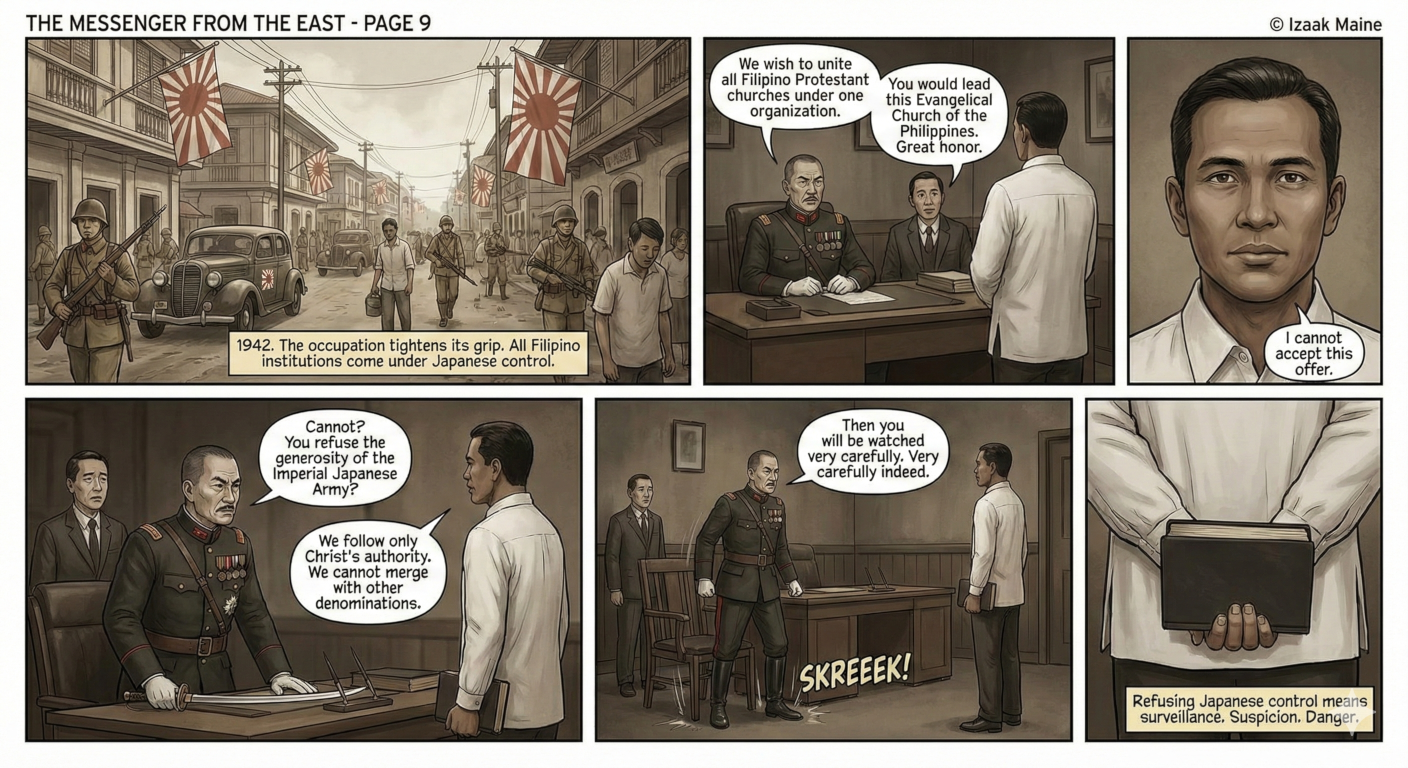
Japanese planes screamed over Manila, dropping bombs that shook the foundations of Felix Manalo’s world. The Philippine Commonwealth, barely a decade into its existence, crumpled under the Imperial Japanese invasion. Within months, the occupation was complete.
For Felix, now fifty-six years old and white-haired, the Japanese occupation presented his greatest test. Faith under persecution is one thing. Faith under the threat of annihilation is another.
In 1942, a Japanese officer in full military regalia sat across from Felix in his church office. An interpreter stood nervously between them.
“Manalo-san, we wish to unite all Filipino Protestant churches under one organization,” the officer said with practiced courtesy. “You would lead this Evangelical Church of the Philippines. A great honor.”
Felix’s response was quiet but unambiguous: “I cannot accept this offer.”
The officer’s expression hardened. “Cannot? You refuse the generosity of the Imperial Japanese Army?”
“Iglesia ni Cristo follows only Christ’s authority,” Felix replied calmly. “We cannot merge with other denominations.”
The chair scraped loudly as the officer stood abruptly. “Then you will be watched very carefully, Manalo-san. Very carefully indeed.”
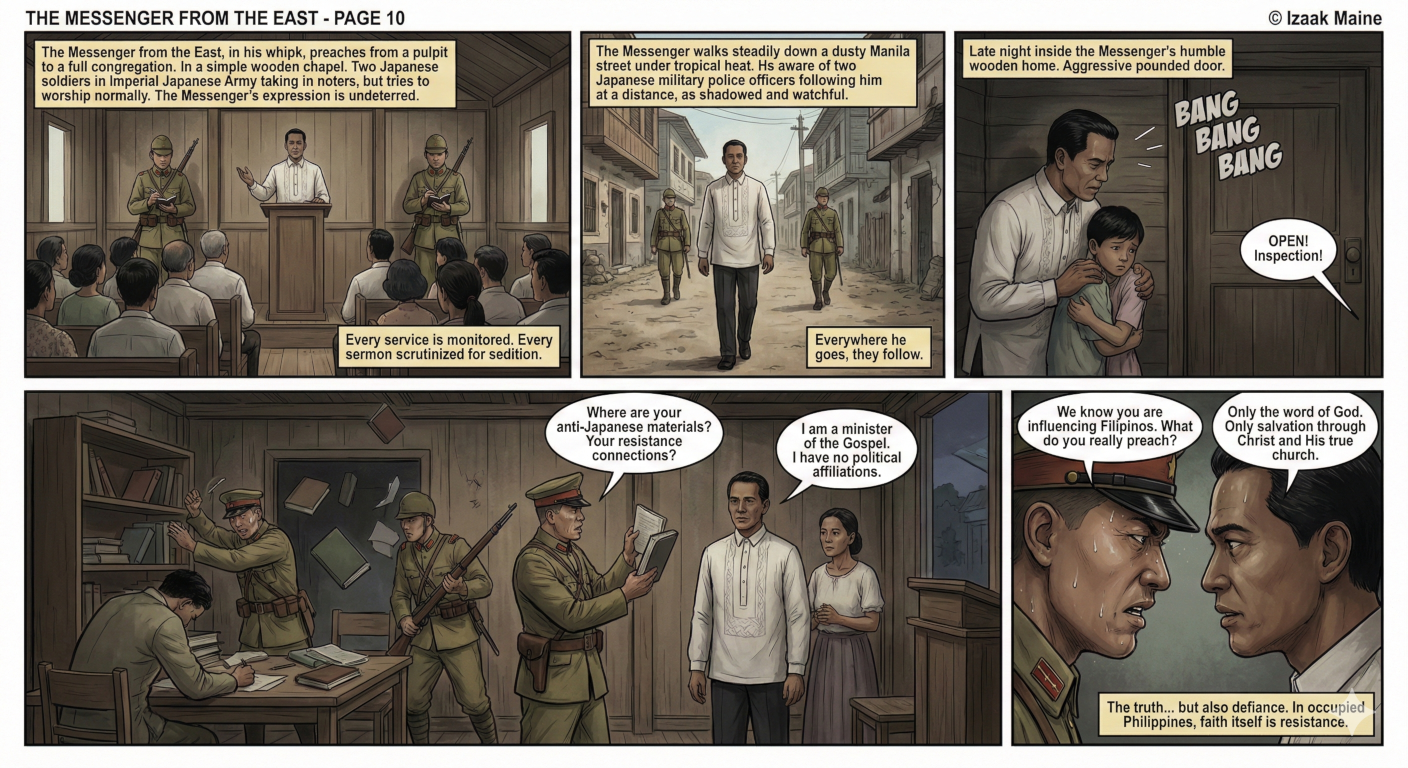
What followed were three years of grinding pressure. Japanese soldiers attended every church service, taking notes, watching for sedition. Military police followed Felix through Manila’s streets. Late-night raids became routine—officers bursting through doors, throwing books and papers across floors, demanding to know where Felix hid his “anti-Japanese materials” and “resistance connections.”
“I am a minister of the Gospel,” Felix repeated each time, his voice steady even as his home was violated. “I have no political affiliations. I preach only the word of God.”
But in occupied Philippines, faith itself was resistance. Every sermon proclaiming Christ’s ultimate authority was an implicit rejection of Japanese supremacy. Every gathering of Filipinos united in religious identity was a potential nucleus of nationalist resistance.
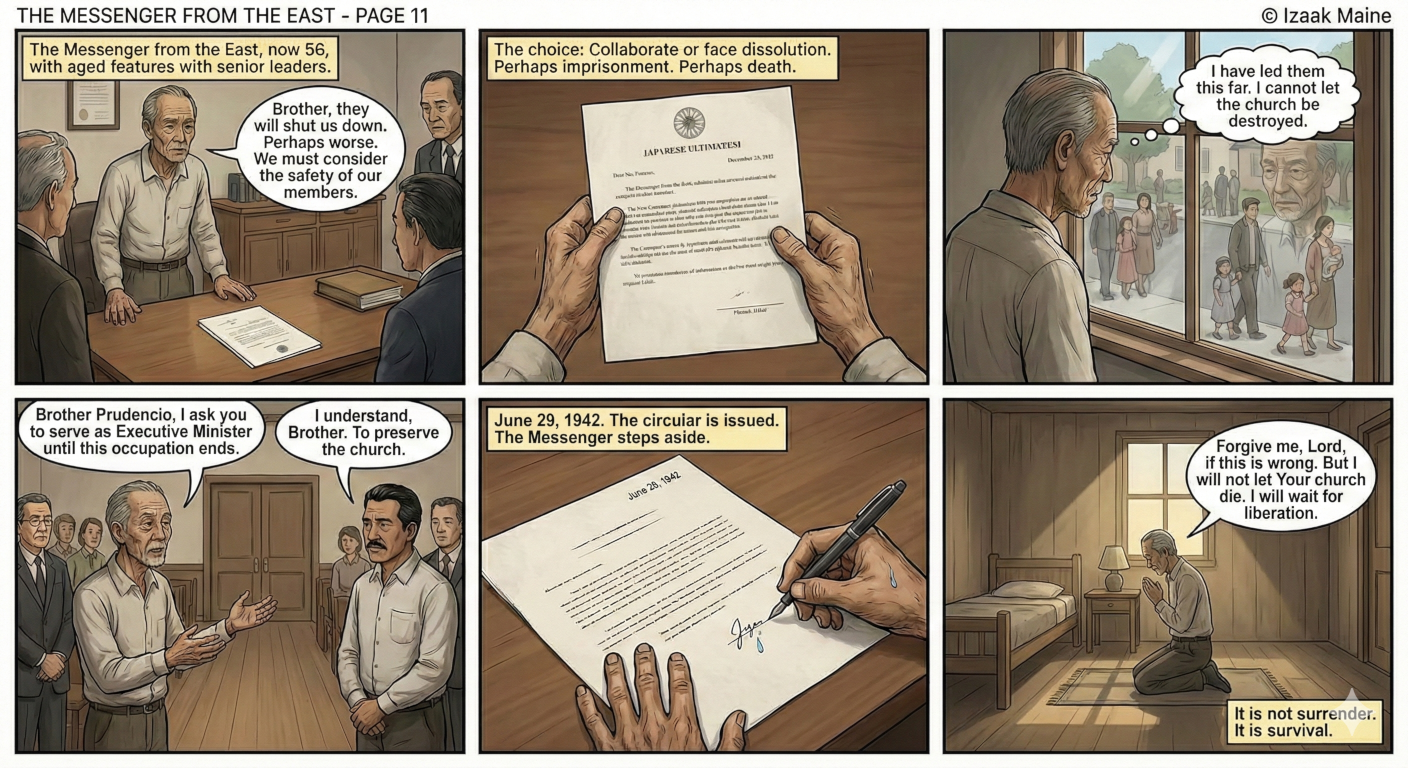
The pressure intensified. Finally, in June 1942, faced with the threat of the church’s complete dissolution—or worse—Felix made a decision that would haunt him for the rest of his life.
He agreed to step aside as Executive Minister, installing Prudencio Vasquez in his place to satisfy Japanese demands. The circular was dated June 29, 1942. Felix signed it with a trembling hand, a tear falling on the paper.
That night, alone in the empty church, Felix knelt at the altar. “Forgive me, Lord, if this is wrong,” he prayed, his voice breaking. “But I will not let Your church die. I will wait for liberation.”
It was compromise, yes. But it was also survival—and Felix Manalo, the messenger who had walked away from everything in 1912 to find truth, understood that sometimes truth requires living to fight another day.
Vindication
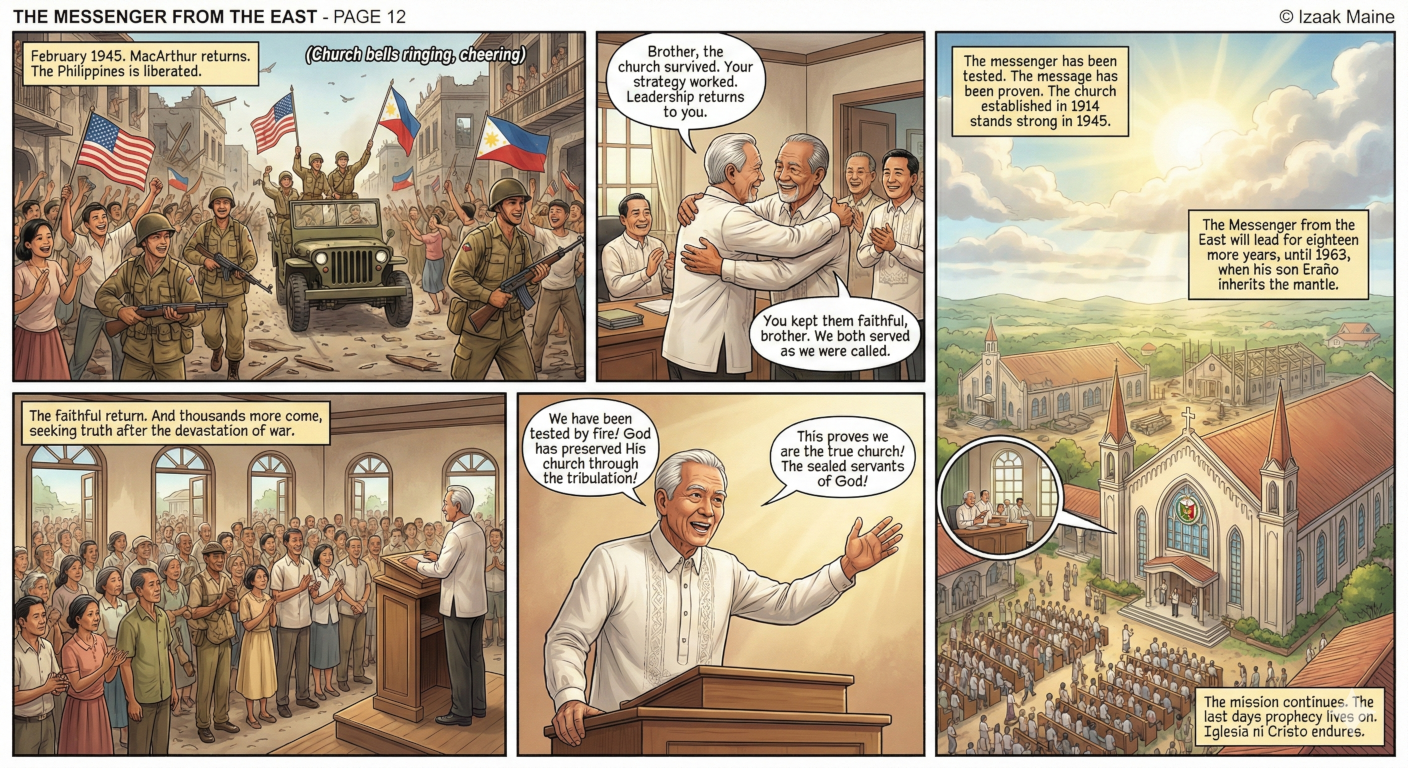
February 1945. General Douglas MacArthur fulfilled his promise: “I shall return.” American and Filipino forces swept through Manila, driving out the Japanese in brutal urban combat that left much of the city in ruins.
Church bells rang across the liberated capital. For Felix Manalo, kneeling in prayer as explosions still echoed in the distance, it was vindication.
Prudencio Vasquez embraced him as a brother when they met after liberation. “Brother Felix, the church survived. Your strategy worked. Leadership returns to you.”
Felix, now fifty-nine, accepted the mantle once more. “You kept them faithful, brother. We both served as we were called.”
The first post-war service drew crowds that overflowed the chapel, with people pressing against windows to hear inside. War-weary Filipinos, having survived unspeakable horrors, came seeking meaning, seeking truth, seeking proof that God had not abandoned them.
Felix, white-haired but unbowed, preached with renewed fire: “We have been tested by fire! God has preserved His church through the tribulation! This proves we are the true church—the sealed servants of God!”
The growth was explosive. Iglesia ni Cristo emerged from World War II stronger than it had entered. For believers, it was clear evidence of divine protection. The messenger had been tested. The message had been proven.
Felix Manalo would lead for eighteen more years, until his death on April 12, 1963. His son, Eraño Manalo, inherited the mantle, continuing the mission his father had begun in a locked room in Pasay fifty years earlier.
Legacy
Today, Iglesia ni Cristo claims millions of members worldwide, with its distinctive Art Deco and modernist church buildings visible across the Philippine landscape and in Filipino communities globally. It remains one of the Philippines’ most politically influential institutions, regularly delivering bloc votes that can swing elections.
For scholars of religion, the movement represents a fascinating case study in indigenous Christian innovation—a Filipino religious leader reinterpreting biblical prophecy to place his nation at the center of salvation history. For believers, Felix Manalo’s story is simply truth: the fulfillment of prophecy, the restoration of Christ’s original church, the sealing of God’s servants before the end times.
Was Felix Manalo a prophet or a gifted religious entrepreneur? A messenger from God or a man who experienced a profound psychological crisis in a rented room and built a theology around it? The question, ultimately, may matter less than what his movement reveals about faith, identity, and the human need for meaning.
What’s undeniable is this: a poor, barely educated Filipino man who began asking questions as a child watching revolution’s violence created a religious movement that outlived Spanish colonialism, American occupation, Japanese invasion, and continues to shape Philippine society more than a century after those first baptisms in the Pasig River.
The messenger from the east may have emerged from obscurity, but his message—for millions—endures.