Paul (Apostle to the Gentiles)
A Roman citizen dragged across an empire on false charges, Paul of Tarsus stood before Nero Caesar with nothing but scars, truth, and unshakeable conviction — dismantling accusations of sedition while proclaiming a crucified king whose kingdom transcends Rome itself. His defense was not a plea for mercy but a masterclass in courage: citing law, exposing his accusers’ greed, and warning even Caesar that all empires fall and all knees will bow. In chains yet unbroken, this tent-making apostle spoke words that would outlive the very empire judging him.
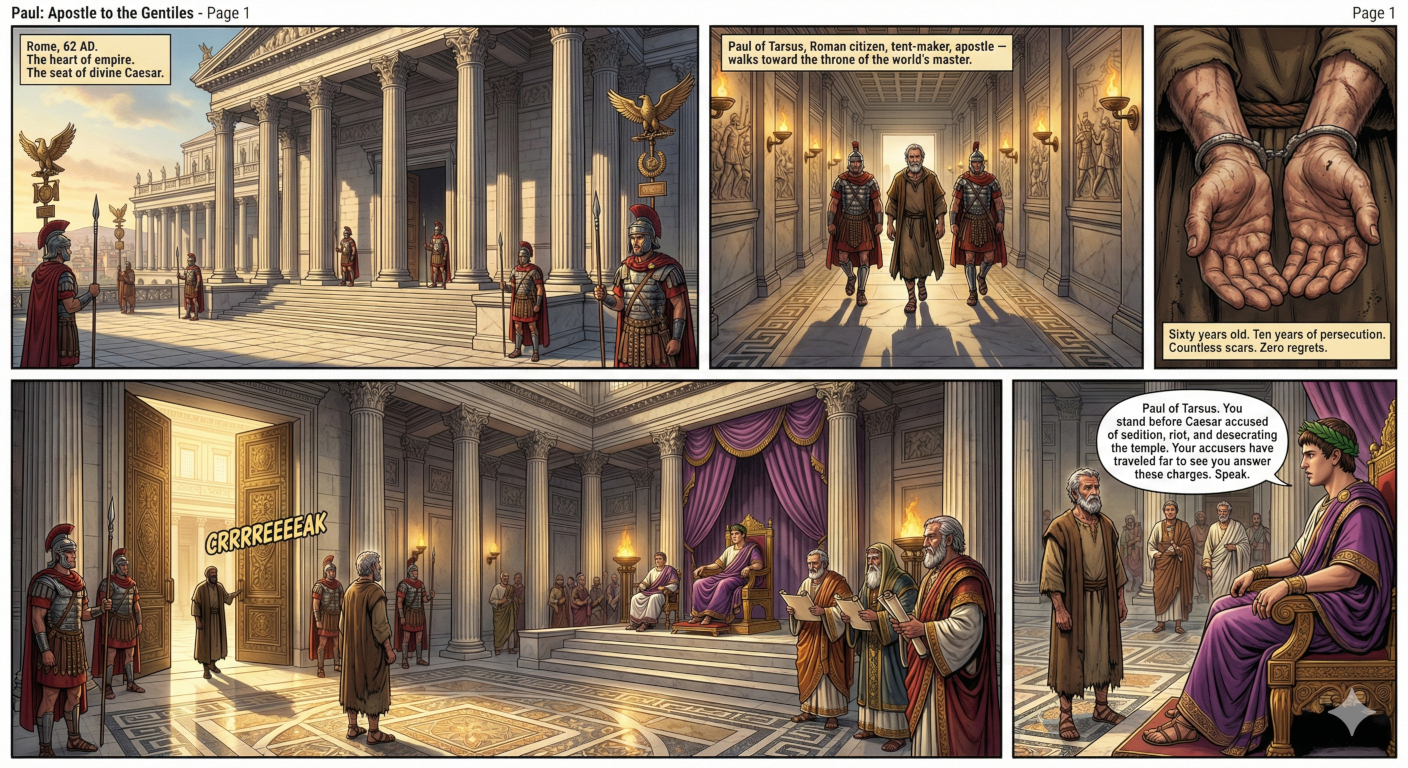
The marble floors of the imperial judgment hall gleamed cold beneath Paul’s sandaled feet. Above him, seated on the raised tribunal draped in imperial purple, sat Nero Caesar — master of the known world, pontifex maximus, the divine Augustus. To the right stood his accusers: Tertullus the orator with his practiced sneer, representatives from the Sanhedrin with their phylacteries and hatred, and various provincial officials who had made the journey to Rome for this moment.
Paul’s wrists bore the marks of chains recently removed. His body, scarred from a decade of persecution, stood unbowed. His eyes — still sharp despite years of strain and that blinding on the Damascus road — met Caesar’s gaze without flinching. He was sixty years old, gray-bearded, weathered like ancient leather, but his voice when it came was clear and strong.
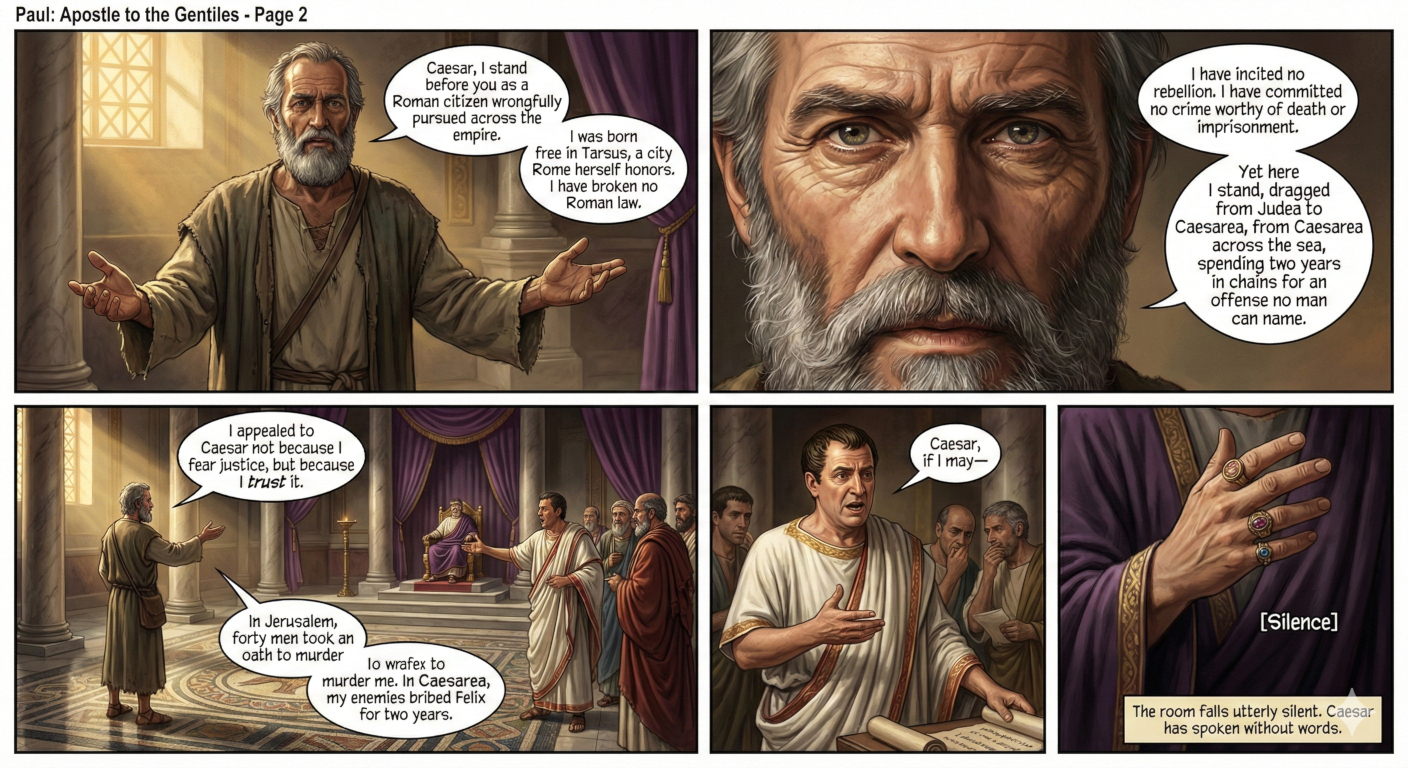
“Caesar,” Paul began, his Greek flawless, his Latin adequate, “I stand before you as a Roman citizen wrongfully pursued across the empire. I was born free in Tarsus, a city Rome herself honors. I have broken no Roman law. I have incited no rebellion. I have committed no crime worthy of death or imprisonment. Yet here I stand, dragged from Judea to Caesarea, from Caesarea across the sea, spending two years in chains for an offense no man can name.”
He paused, letting the words settle like stones into still water.
“I appealed to Caesar not because I fear justice, but because I trust it. In Jerusalem, forty men took an oath to murder me. In Caesarea, my enemies bribed Felix for two years, hoping I would bribe him in return to secure freedom. When Festus arrived, they demanded I be sent back to Jerusalem — not for trial, but for ambush. At every turn, Caesar, they have sought my blood through treachery because they cannot convict me through law.”
Tertullus shifted, preparing to interrupt, but Nero raised one ringed hand. The room fell silent. Paul continued.
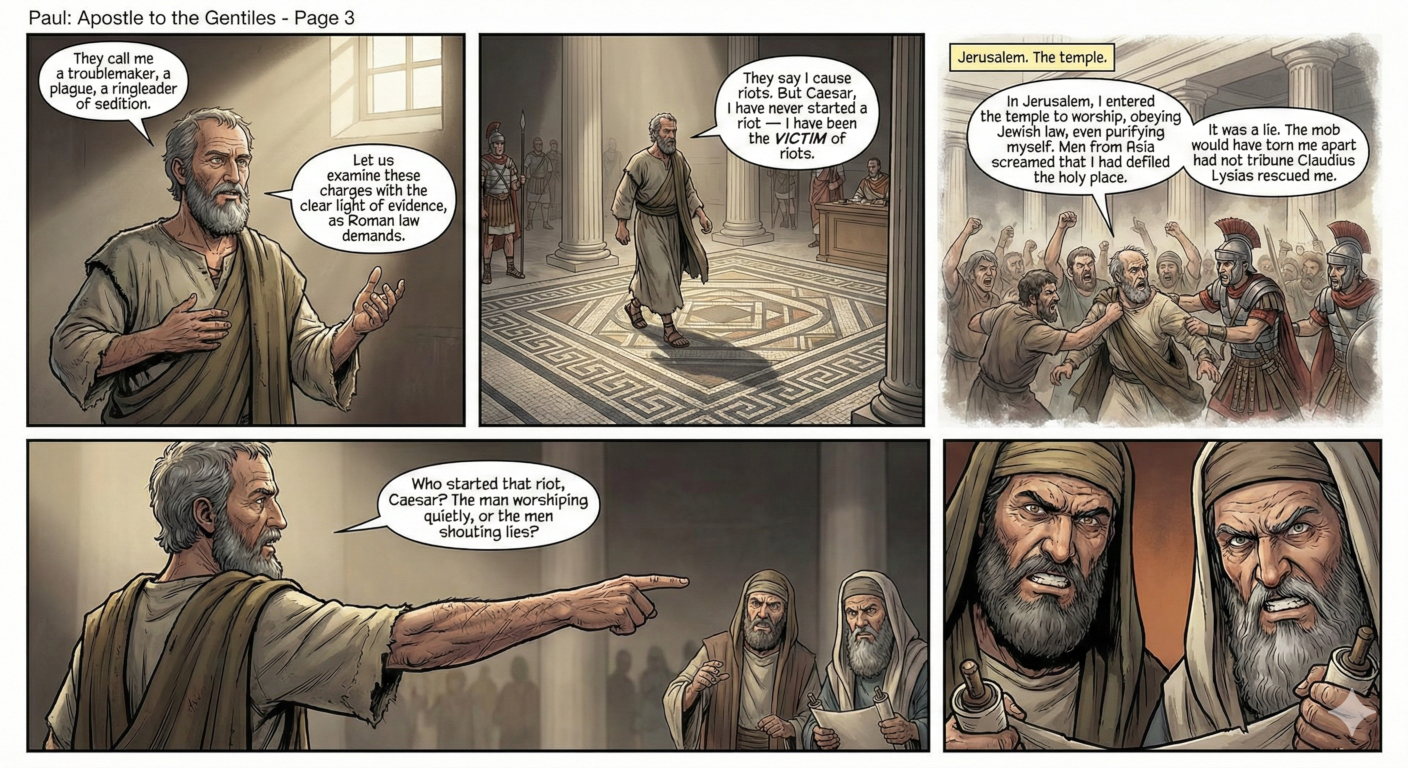
“They call me a troublemaker, a plague, a ringleader of sedition. Let us examine these charges with the clear light of evidence, as Roman law demands.”
Paul’s voice rose, gaining momentum like a ship catching wind.
“They say I cause riots. But Caesar, I have never started a riot — I have been the victim of riots. In Jerusalem, I entered the temple to worship, obeying Jewish law, even purifying myself according to their customs. Men from Asia saw me and screamed that I had defiled the holy place, that I had brought Greeks past the barrier. It was a lie — they produced no Greek, no evidence, no witness. The mob seized me and would have torn me apart had not the Roman tribune Claudius Lysias rescued me. Who started that riot, Caesar? The man worshiping quietly, or the men shouting lies?”
He turned slightly, acknowledging his accusers with a gesture both dismissive and precise.
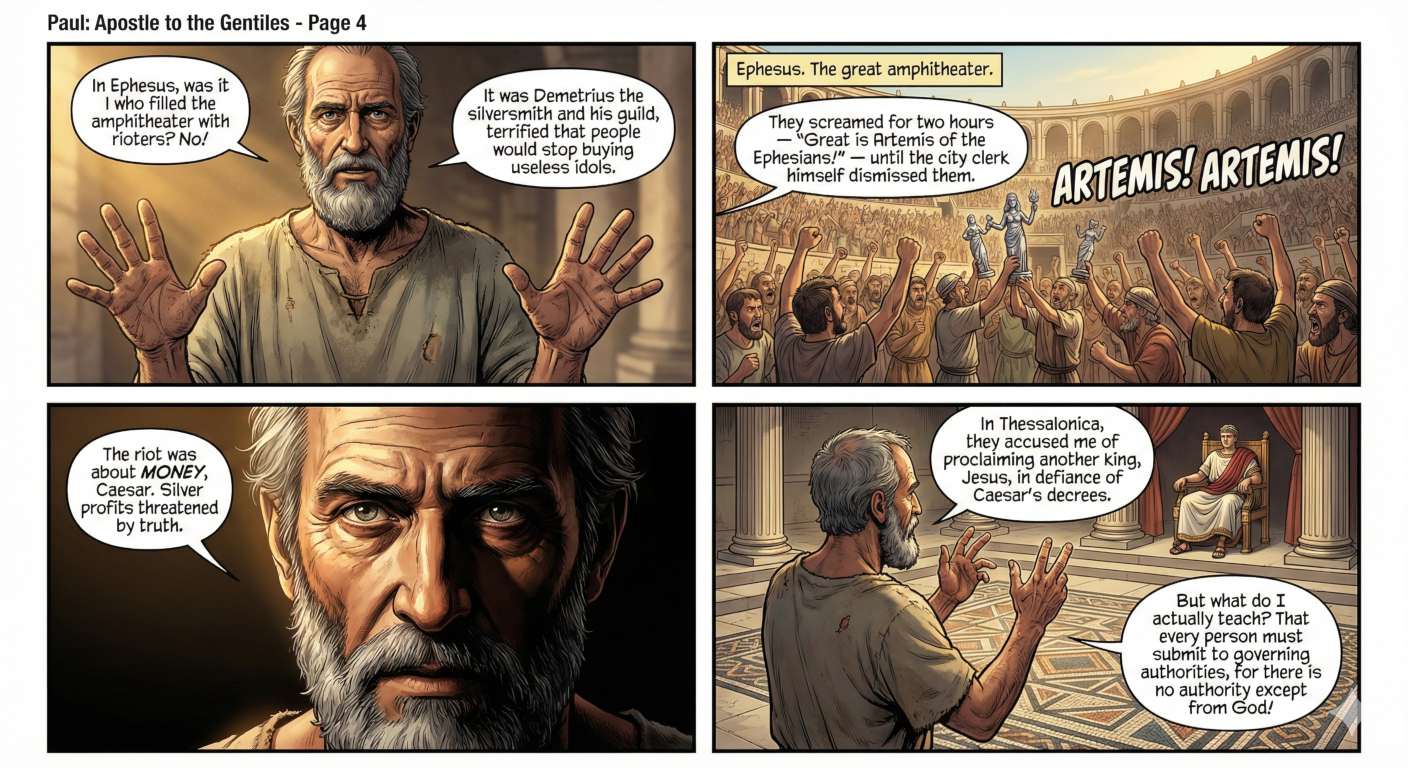
“In Ephesus, was it I who filled the amphitheater with rioters? No! It was Demetrius the silversmith and his guild, terrified that people would stop buying useless idols. They screamed for two hours — ‘Great is Artemis of the Ephesians!’ — until the city clerk himself dismissed them, stating clearly that I had committed no sacrilege. The riot was about money, Caesar. Silver profits threatened by truth.”
Paul’s eyes blazed now, his scholar’s mind cataloging evidence like a merchant tallying accounts.
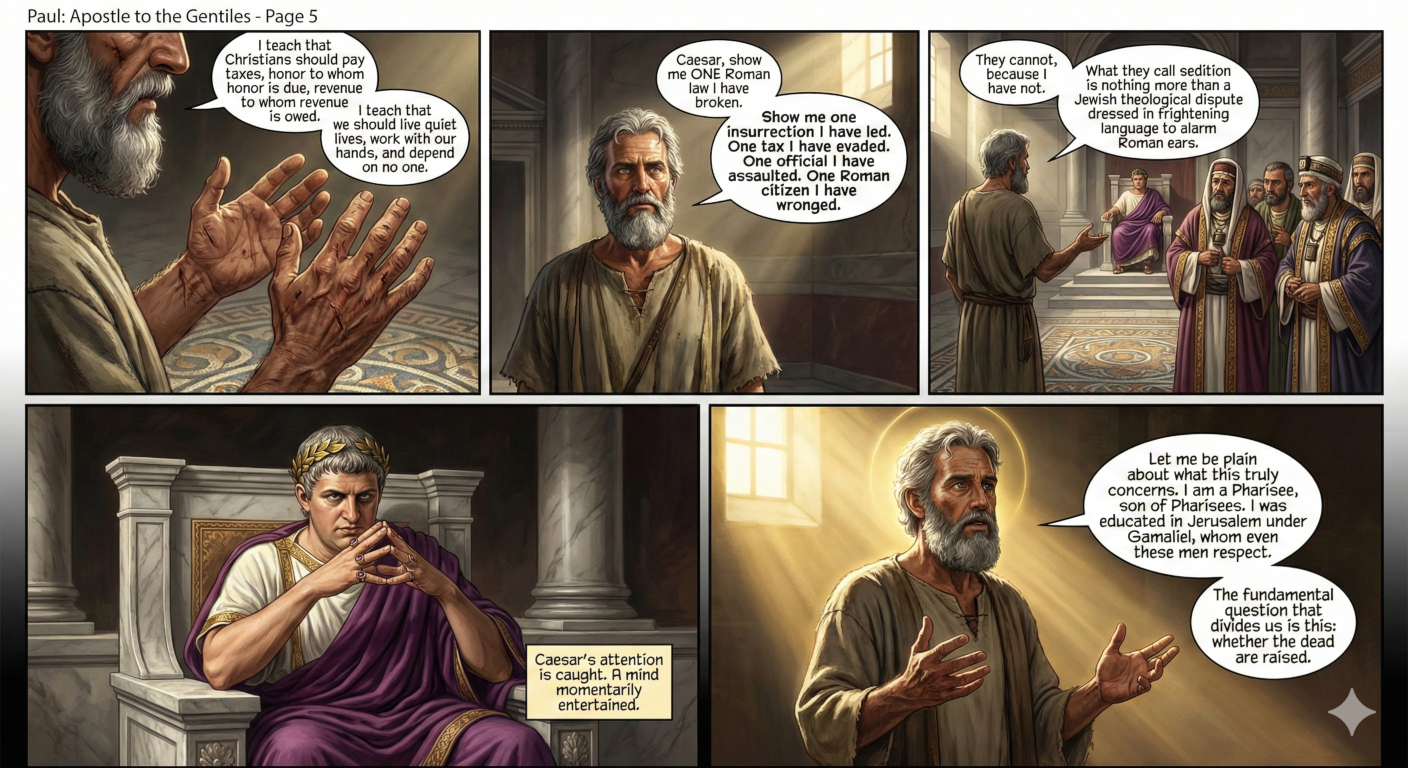
“In Thessalonica, they accused me of proclaiming another king, Jesus, in defiance of Caesar’s decrees. But what do I actually teach? I teach in my letters, which can be produced and examined, that every person must submit to governing authorities, for there is no authority except from God, and those that exist have been instituted by God. I teach that Christians should pay taxes, honor to whom honor is due, revenue to whom revenue is owed. I teach that we should live quiet lives, mind our own affairs, work with our hands, and depend on no one.”
He spread those hands now, calloused from tentmaking, scarred from beatings.
“Caesar, show me one Roman law I have broken. Show me one insurrection I have led. Show me one tax I have evaded, one official I have assaulted, one Roman citizen I have wronged. They cannot, because I have not. What they call sedition is nothing more than a Jewish theological dispute dressed in frightening language to alarm Roman ears.”
Nero leaned forward slightly. Paul recognized the shift — intellectual curiosity, perhaps, or merely the attention of a man momentarily entertained.
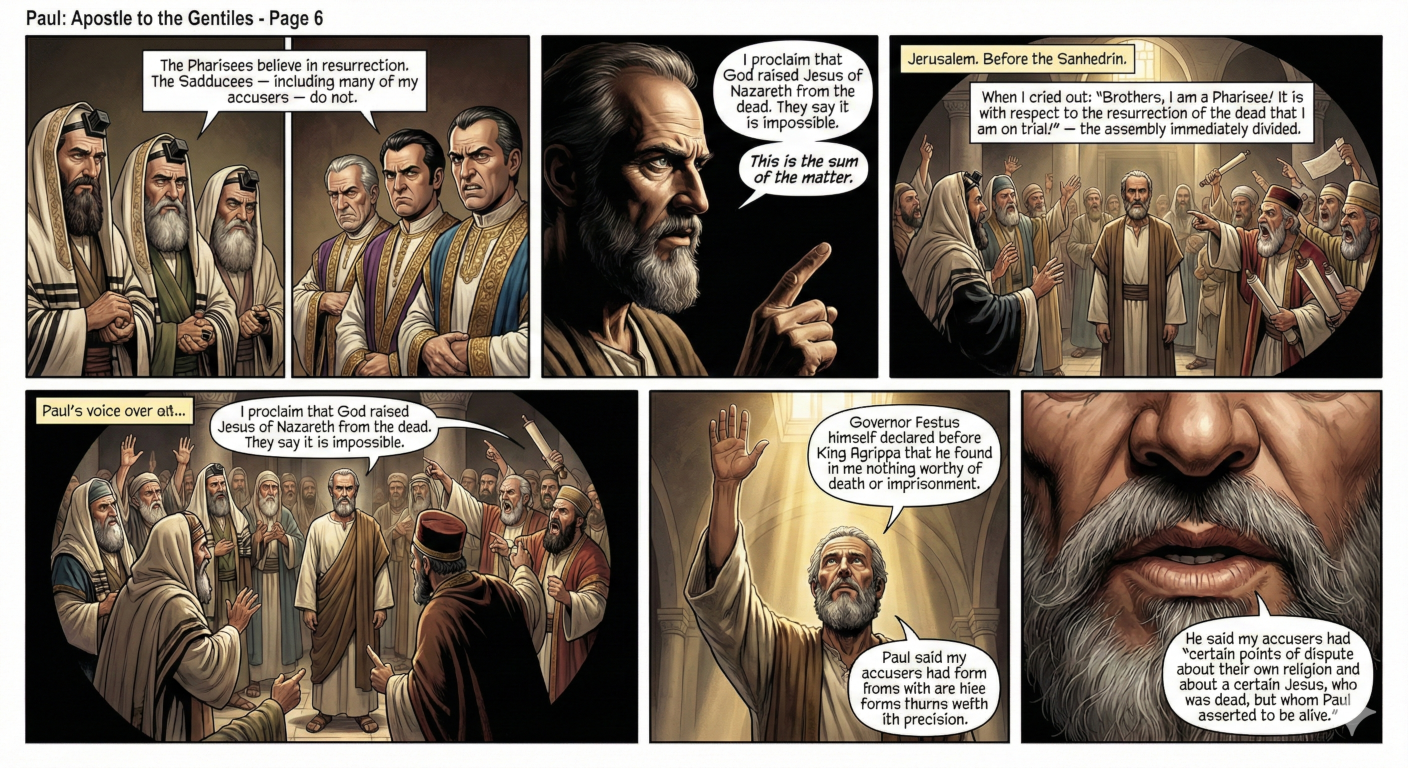
“Let me be plain about what this truly concerns. I am a Pharisee, son of Pharisees. I was educated in Jerusalem under Gamaliel, whom even these men respect. The fundamental question that divides us is this: whether the dead are raised. The Pharisees believe in resurrection. The Sadducees — including many of my accusers — do not. I proclaim that God raised Jesus of Nazareth from the dead. They say it is impossible. This is the sum of the matter.”
Paul’s voice took on an edge, sharp as Damascus steel.
“When I was brought before the Sanhedrin, I cried out: ‘Brothers, I am a Pharisee, a son of Pharisees. It is with respect to the hope and resurrection of the dead that I am on trial!’ Immediately the assembly divided — Pharisees defending me, Sadducees attacking me. Even the Roman tribune saw it was a theological dispute, not a criminal matter. Governor Festus himself declared before King Agrippa that he found in me nothing worthy of death or imprisonment. He said my accusers had ‘certain points of dispute about their own religion and about a certain Jesus, who was dead, but whom Paul asserted to be alive.’”
He paused, letting the admission from Rome’s own official hang in the air.
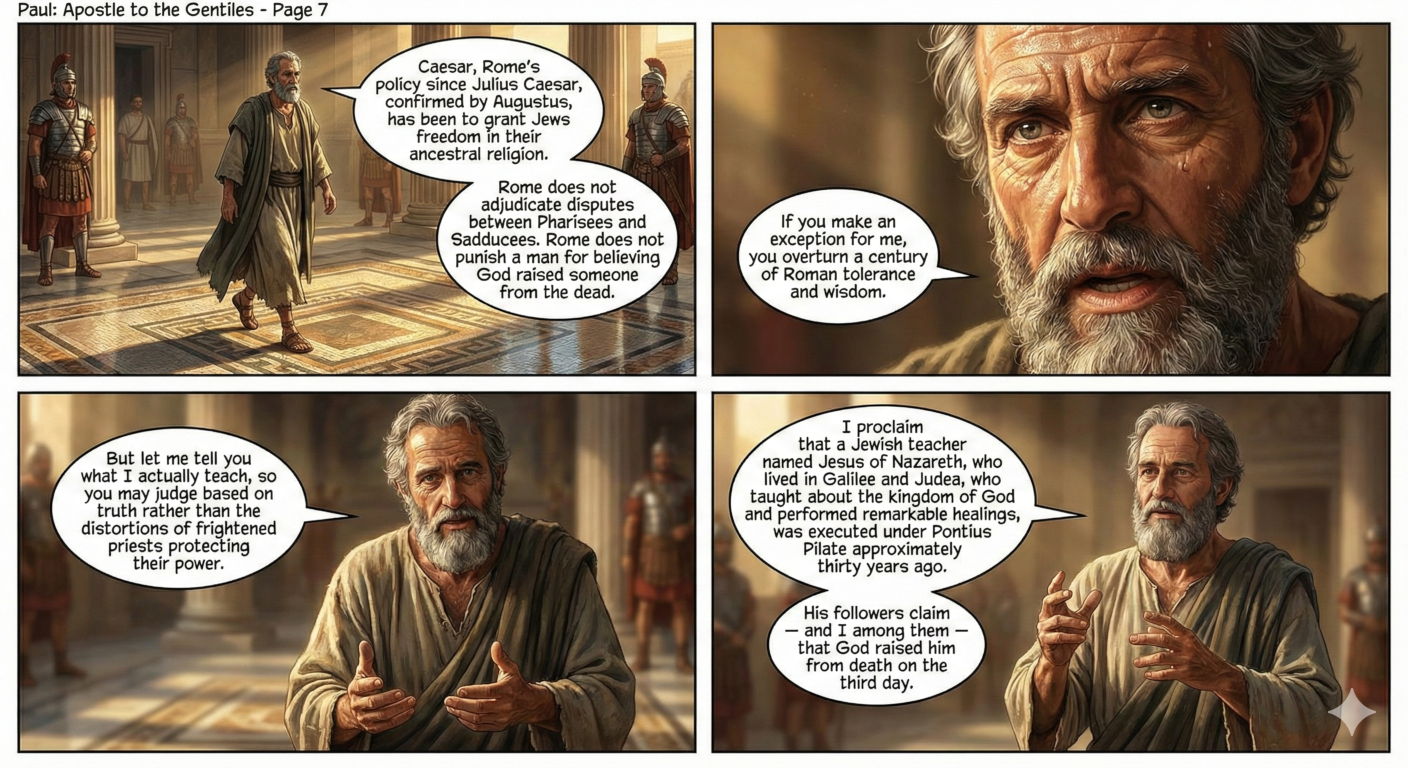
“Caesar, Rome’s policy since Julius Caesar, confirmed by Augustus, has been to grant Jews freedom in their ancestral religion. Rome does not adjudicate disputes between Pharisees and Sadducees. Rome does not punish a man for believing God raised someone from the dead. If you make an exception for me, you overturn a century of Roman tolerance and wisdom.”
Paul began to pace now, three steps one way, three steps back — a teacher’s movement, ingrained from years in synagogues and lecture halls.
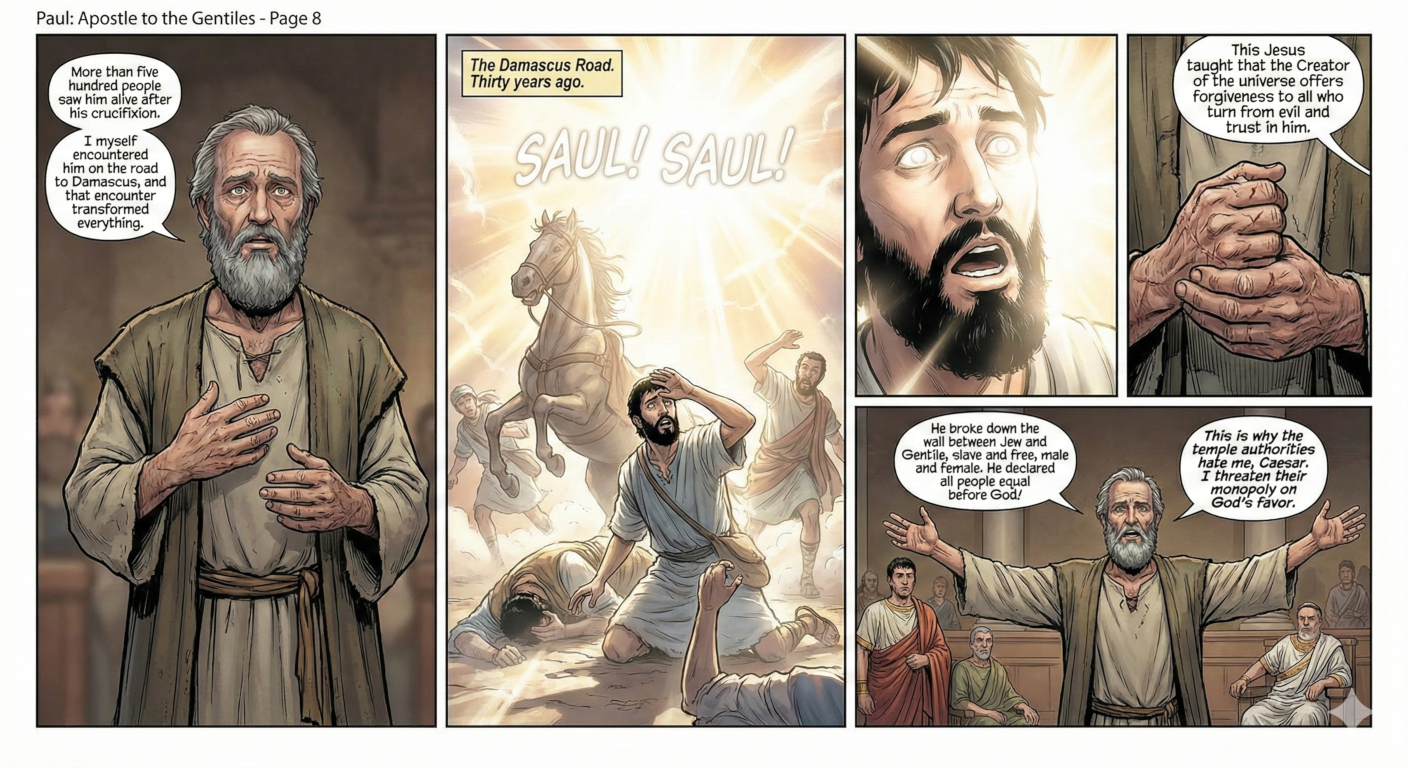
“But let me tell you what I actually teach, so you may judge based on truth rather than the distortions of frightened priests protecting their power. I proclaim that a Jewish teacher named Jesus of Nazareth, who lived in Galilee and Judea, who taught about the kingdom of God and performed remarkable healings, was executed under Pontius Pilate approximately thirty years ago. His followers claim — and I among them — that God raised him from death on the third day. More than five hundred people saw him alive after his crucifixion. I myself encountered him on the road to Damascus, and that encounter transformed everything.”
His voice dropped, became intimate, as though speaking to one man rather than a court.
“This Jesus taught that the Creator of the universe offers forgiveness to all who turn from evil and trust in him. He broke down the wall between Jew and Gentile, slave and free, male and female. He declared all people equal before God — not based on ethnicity, not based on ceremony, not based on religious performance, but based on faith. This is why the temple authorities hate me, Caesar. I threaten their monopoly on God’s favor. I tell common people they can approach the Creator directly, without their permission or their profits.”
Paul’s hands clenched, and his voice rose again, gathering force.
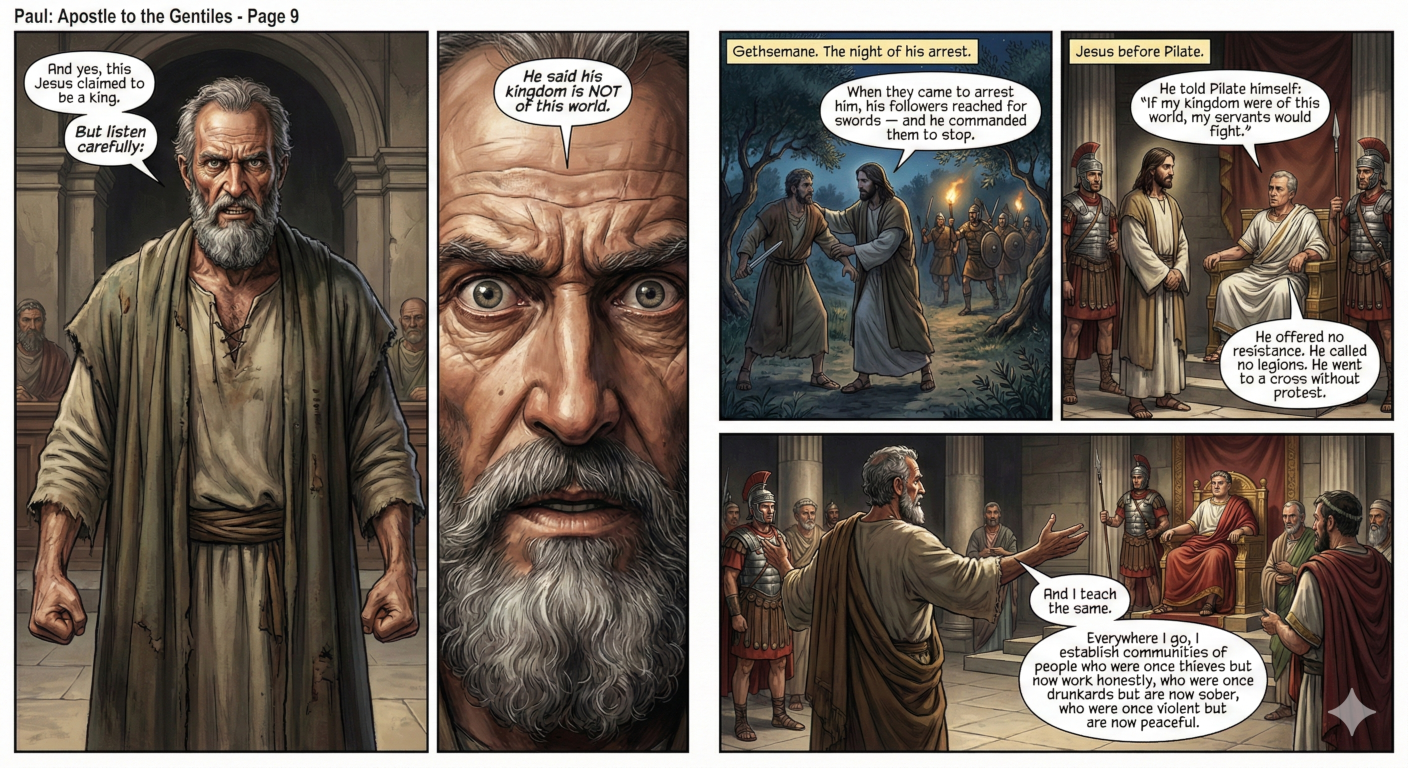
“And yes, this Jesus claimed to be a king. But listen carefully: he said his kingdom is not of this world. When they came to arrest him, his followers reached for swords — and he commanded them to stop. He told Pilate himself: ‘If my kingdom were of this world, my servants would fight.’ He offered no resistance. He called no legions. He mounted no rebellion. He went to a cross without protest.”
The apostle’s eyes swept the room, challenging anyone to contradict him.
“And I teach the same. Everywhere I go, I establish communities of people who were once thieves but now work honestly, who were once drunkards but are now sober, who were once violent but are now peaceful. I teach that whatever is true, whatever is honorable, whatever is just, whatever is pure, whatever is lovely, whatever is commendable — think about these things. I teach that love is patient and kind, that it does not envy or boast, that it is not arrogant or rude. Does this sound like sedition to you, Caesar?”
He let the question hang, unanswered, rhetorical but pointed.
“Let me tell you who I was before Damascus, so you understand what conviction drives me. I was like them — “ he gestured toward his accusers “ — zealous beyond measure for the traditions of my fathers. I persecuted this movement with murderous intent. I stood holding the coats of those who stoned Stephen, the first martyr, and I approved of his execution. I dragged men and women from their homes and threw them into prison. I punished them in synagogue after synagogue, trying to force them to blaspheme. I was so enraged that I pursued them even to foreign cities.”
Paul’s voice cracked slightly — not with weakness, but with the weight of memory.
“Then on the Damascus road, a light brighter than the sun struck me down. I heard a voice: ‘Saul, Saul, why do you persecute me?’ I said, ‘Who are you, Lord?’ And he replied: ‘I am Jesus, whom you are persecuting.’ For three days I was blind. In that darkness, everything I thought I knew was overturned. I had been persecuting the very God I claimed to serve.”
He straightened, his voice steadying.
“Caesar, what madman fabricates a comfortable lie and then suffers for it? Since that day, I have been beaten with rods three times — Roman punishment for a Roman citizen. I have been whipped by Jews five times, receiving thirty-nine lashes each time. I have been stoned and left for dead in Lystra. I have been shipwrecked three times, spending a night and day adrift in the open sea. I have been in danger from rivers, from bandits, from my own people, from Gentiles, in the city, in the wilderness, at sea. I have known hunger, thirst, cold, and nakedness.”
His scarred hands rose, trembling slightly — not from fear, but from the sheer force of what he was saying.
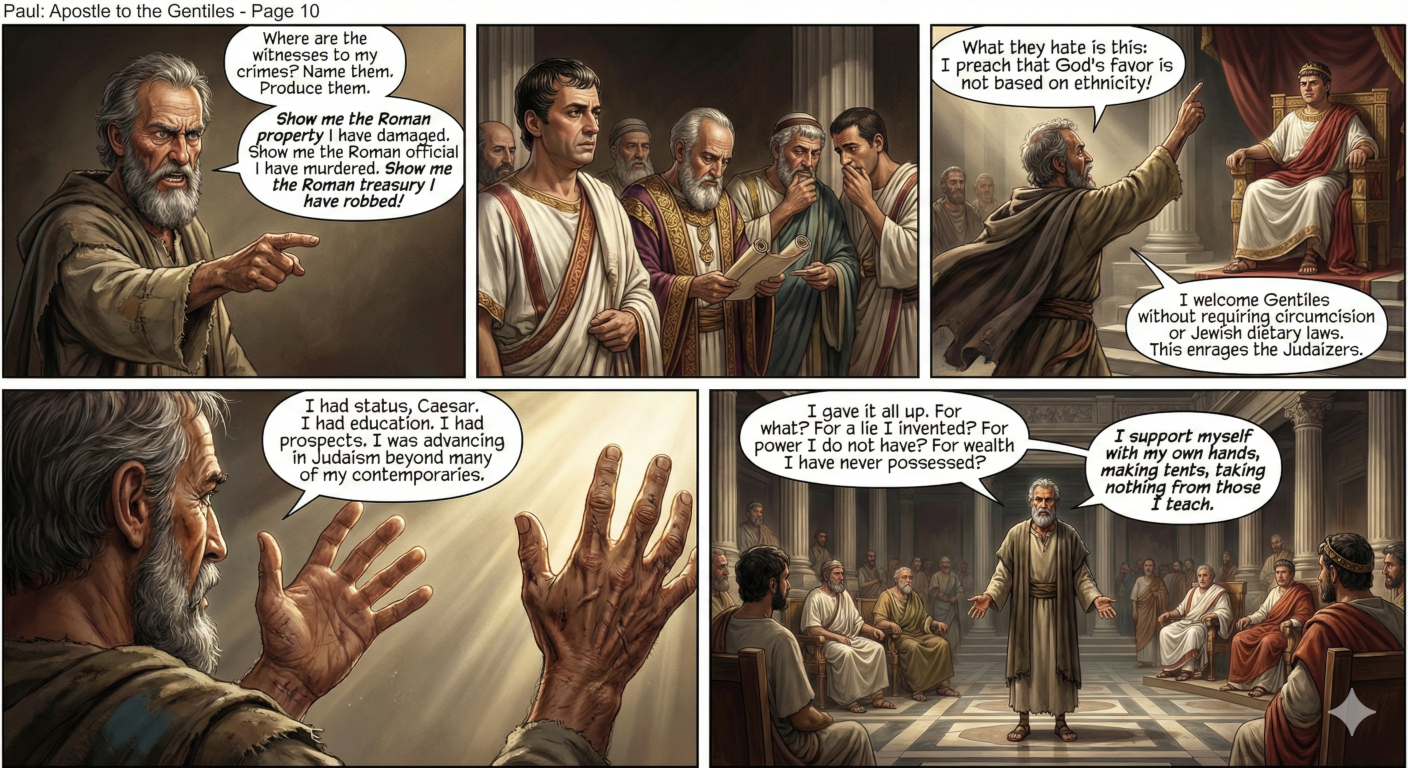
“I had status, Caesar. I had education. I had prospects. I was advancing in Judaism beyond many of my contemporaries, extremely zealous for my ancestral traditions. I gave it all up. For what? For a lie I invented? For power I do not have? For wealth I have never possessed? I support myself with my own hands, making tents, taking nothing from those I teach. What profit is there in this madness, unless it is true?”
Paul turned back to his accusers, his voice now edged with righteous anger.
“Where are the witnesses to my crimes? Name them. Produce them. Show me the Roman property I have damaged. Show me the Roman official I have murdered. Show me the Roman treasury I have robbed. Show me the Roman garrison I have attacked. You cannot, because there is nothing to show.”
He spun back to Caesar, his entire being focused like a spear point.
“What they hate is this: I preach that God’s favor is not based on ethnicity. I welcome Gentiles without requiring them to be circumcised or follow Jewish dietary laws. This enrages the Judaizers. I proclaim that ceremonies and sacrifices cannot save anyone — only faith in Christ. This threatens the temple economy. I tell slaves and masters, Jews and Greeks, men and women that they are equal before God. This disrupts every comfortable hierarchy.”
Paul’s voice became iron, uncompromising.
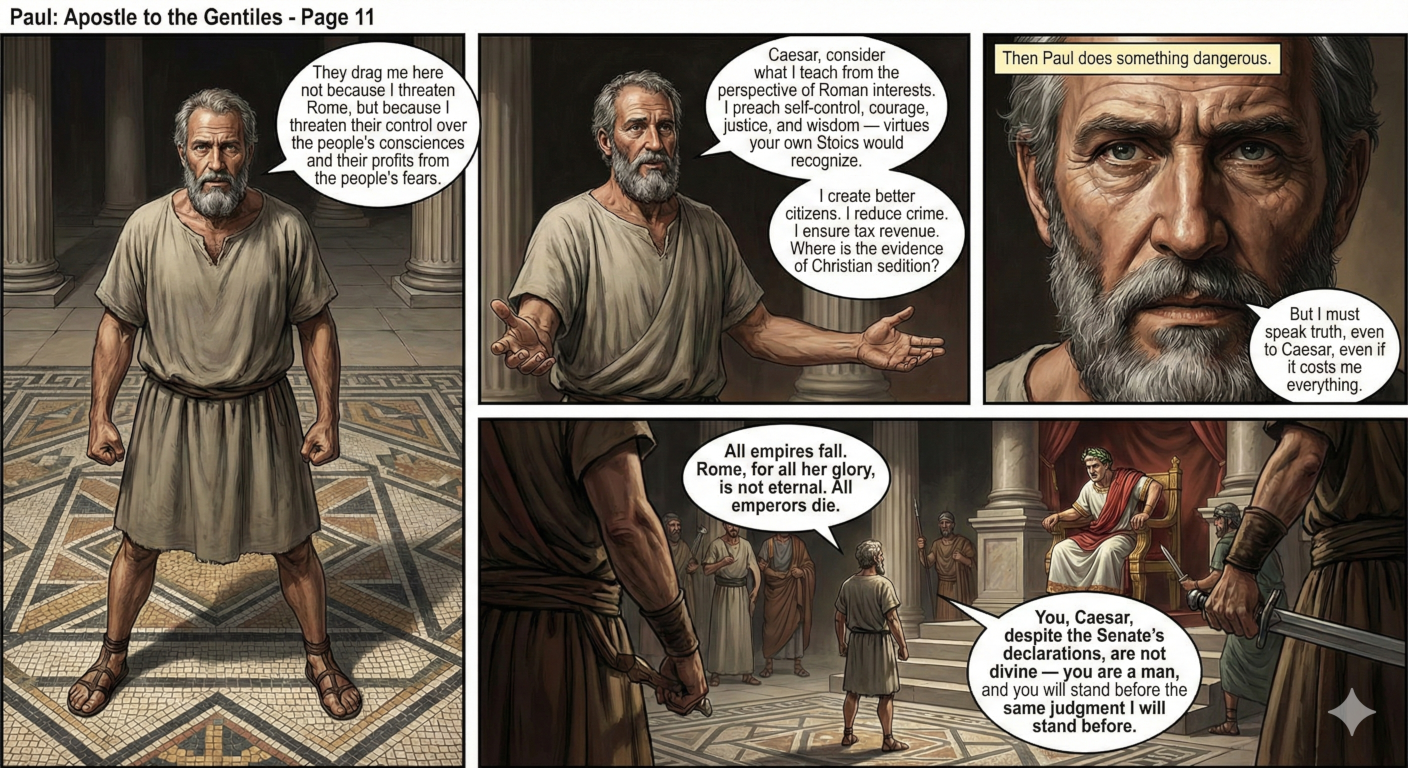
“They drag me here not because I threaten Rome, but because I threaten their control over the people’s consciences and their profits from the people’s fears.”
He paused, drawing breath, and then shifted his approach — an intellectual’s pivot, finding new ground.
“Caesar, consider what I teach from the perspective of Roman interests. I preach self-control, courage, justice, and wisdom — virtues your own Stoics would recognize. I strengthen families by teaching husbands to love their wives as their own bodies, wives to respect their husbands, children to obey parents, fathers not to provoke their children. I create better citizens: ‘Let every person be subject to the governing authorities.’ I reduce crime by transforming criminals into honest workers. I promote peace: ‘If possible, so far as it depends on you, live peaceably with all.’ I ensure tax revenue: ‘Pay to all what is owed to them — taxes to whom taxes are owed, revenue to whom revenue is owed, respect to whom respect is owed, honor to whom honor is owed.’”
His hands spread wide, the gesture both offering and challenging.
“Caesar, you rule an empire of a thousand gods and philosophies. Rome has always been tolerant — Egyptian gods, Syrian gods, Greek gods, mystery cults from Persia. Mine adds one more, but produces better citizens than most. The Christians in Rome work hard, pay taxes, care for the poor, and cause no trouble. Ask your own officials. Search your own records. Where is the evidence of Christian sedition?”
Then Paul did something dangerous. His voice dropped, became grave, and he spoke words that could mean his death.
“But I must speak truth, even to Caesar, even if it costs me everything. All empires fall. Rome, for all her glory, is not eternal. All emperors die. You, Caesar, despite the Senate’s declarations, are not divine — you are a man, and you will stand before the same judgment I will stand before. There is a King whose kingdom has no end, and every knee will bow before him — including yours and mine.”
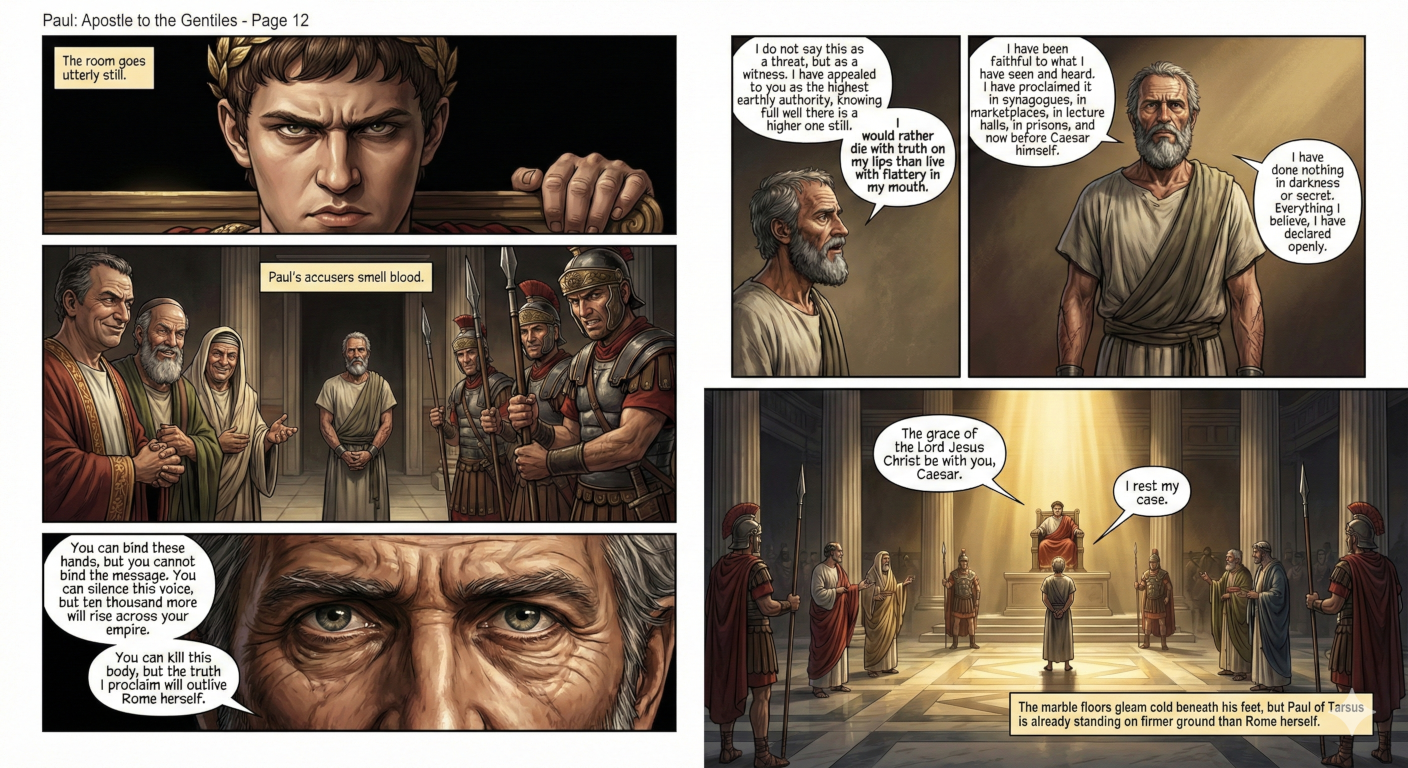
The room went utterly still. Paul’s accusers smiled, smelling blood. But Paul continued, his voice unwavering.
“I do not say this as a threat, but as a witness. I have appealed to you as the highest earthly authority, knowing full well there is a higher one still. I would rather die with truth on my lips than live with flattery in my mouth. You can command my body, but you cannot command my conscience. You can take my life, but you cannot make me deny what I know to be true.”
He stood taller now, his voice rising to its full strength.
“I have been faithful to what I have seen and heard. I have proclaimed it in synagogues, in marketplaces, in lecture halls, in prisons, and now before Caesar himself. I have done nothing in darkness or secret. Everything I believe, I have declared openly. I have not plotted, have not schemed, have not organized armed resistance. I have simply spoken about a crucified man whom God raised from death, and about the implications of that resurrection for every human being.”
Paul’s final words came with the force of a man who had nothing left to lose and everything eternal to gain.
“Caesar, I ask three things. First, acquittal based on evidence — for I have broken no law and committed no crime. Second, protection as a Roman citizen from mob violence and false accusation. Third, freedom to continue my work, which harms no one and helps many.”
He paused, his eyes locked on Nero’s.
“If you find me guilty, name the law I have violated. If you cannot name it, let me go.”
His voice softened slightly, but lost none of its intensity.
“I have lived my entire life with a clear conscience before God and man. I have fought the good fight. I have finished the race. I have kept the faith. Now I await the verdict, but Caesar, hear this: whether I walk from this place in freedom or in chains, to life or to death, I will not recant. I will not compromise. I will not be silent.”
Paul stood silent for a moment, the weight of his words settling over the judgment hall like snow.
“You can bind these hands, but you cannot bind the message. You can silence this voice, but ten thousand more will rise across your empire. You can kill this body, but the truth I proclaim will outlive Rome herself. The gospel is not chained to my fate — it spreads like dawn, inevitable and unstoppable.”
He drew one final breath, and spoke his last words with a strange combination of defiance and benediction.
“Do with me what you will. I have been beaten, shipwrecked, stoned, imprisoned, and hunted. What is death compared to these? I have learned to be content in whatever circumstance I find myself. I know how to be brought low, and I know how to abound. I can do all things through Christ who strengthens me.”
Paul’s voice rang out, final and clear.
“The grace of the Lord Jesus Christ be with you, Caesar. I rest my case.”
He stood in silence, a small, scarred, gray-bearded Jew who had just spoken truth to the master of the world — unafraid, unashamed, unbroken.
The marble floors gleamed cold beneath his feet, but Paul of Tarsus was already standing on firmer ground than Rome herself.