Einstein (Annus Mirabilis)
The Patent Clerk Who Broke Time
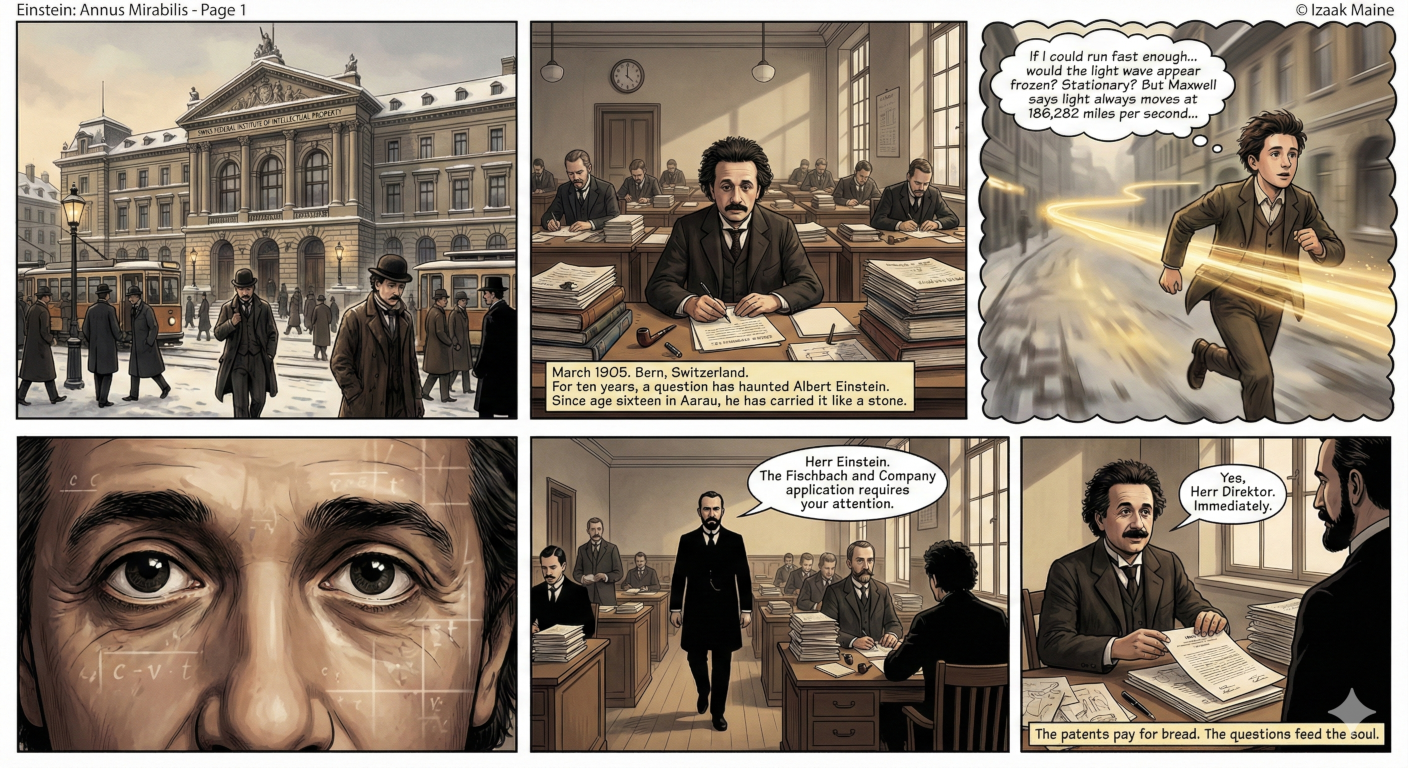
BERN, Switzerland — The offices of the Swiss Federal Patent Office occupy a handsome building on Speichergasse, where in 1905 the fate of the universe was being decided between examinations of electrical synchronization devices and electromagnetic regulators.
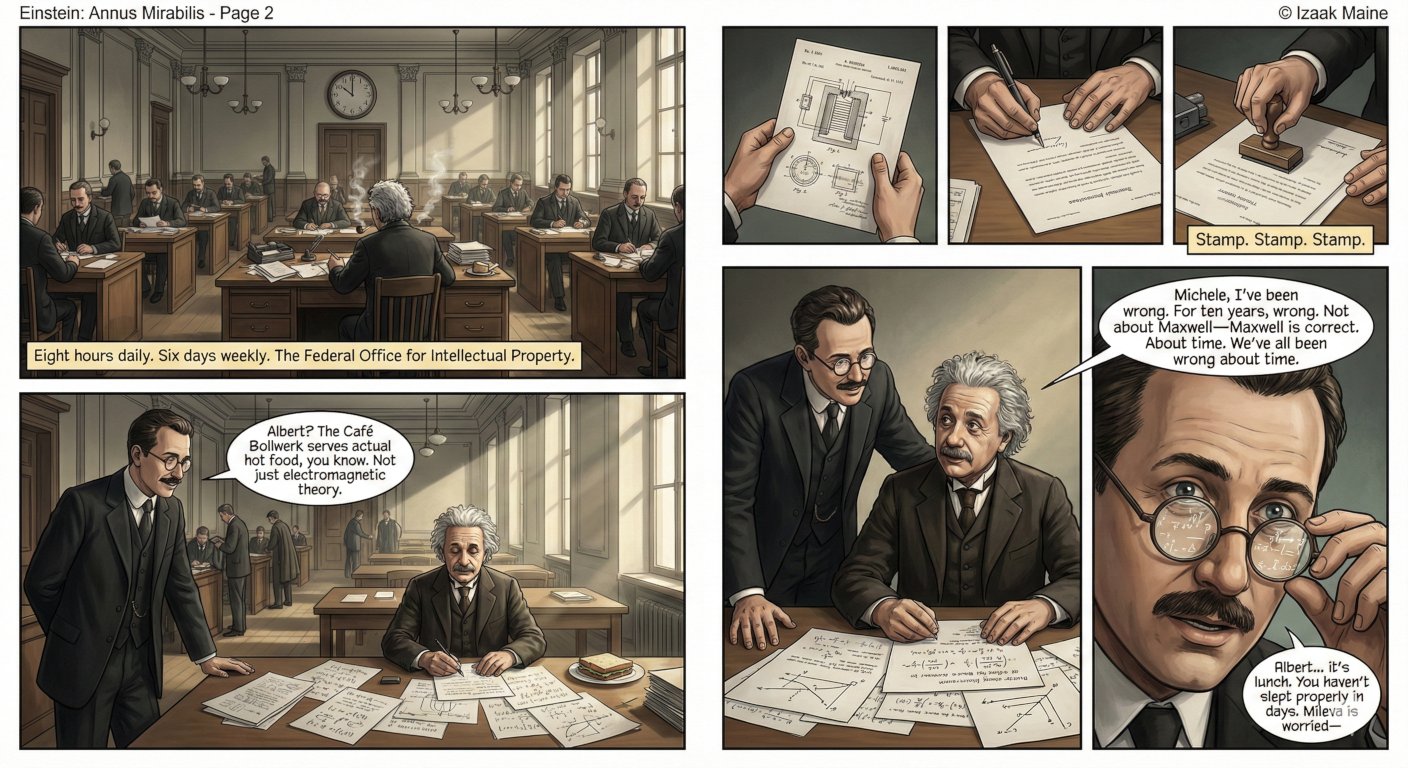
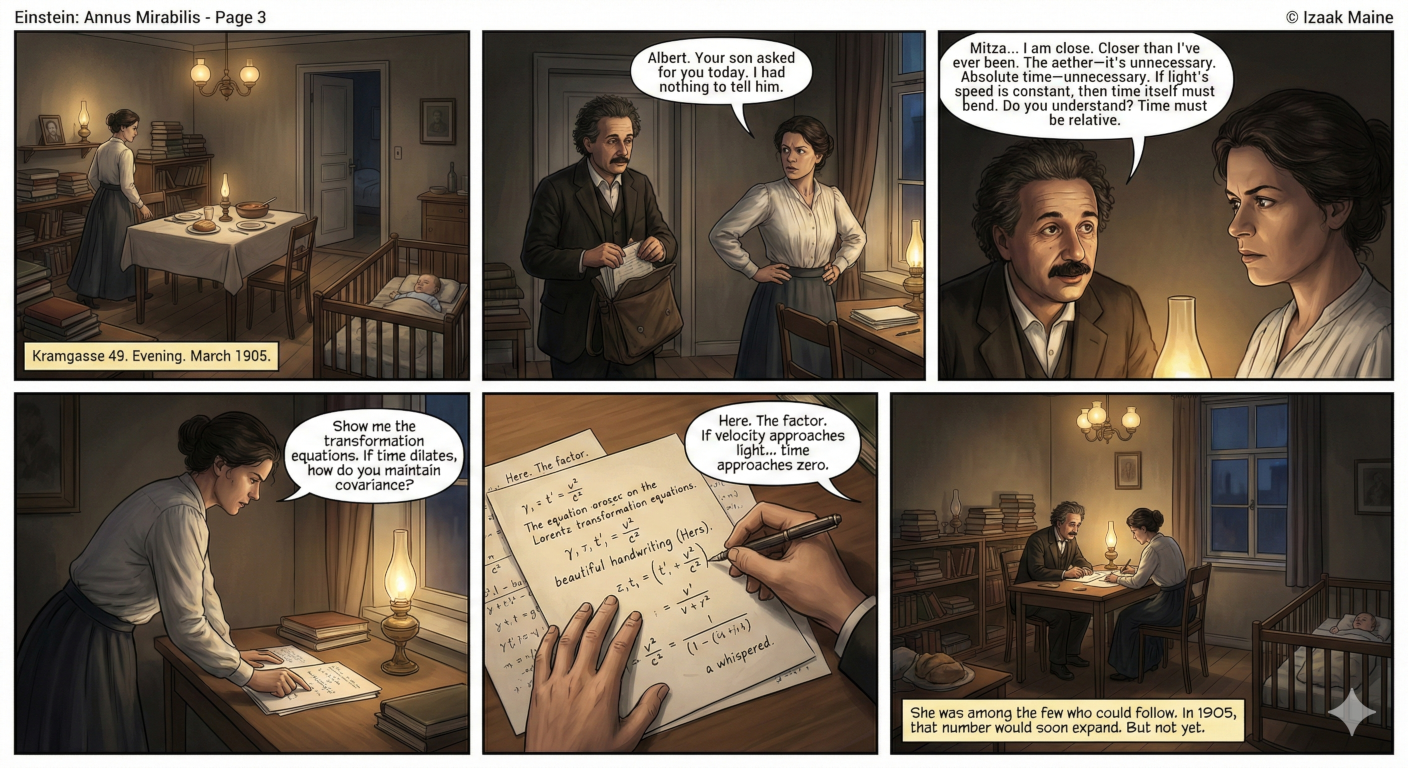
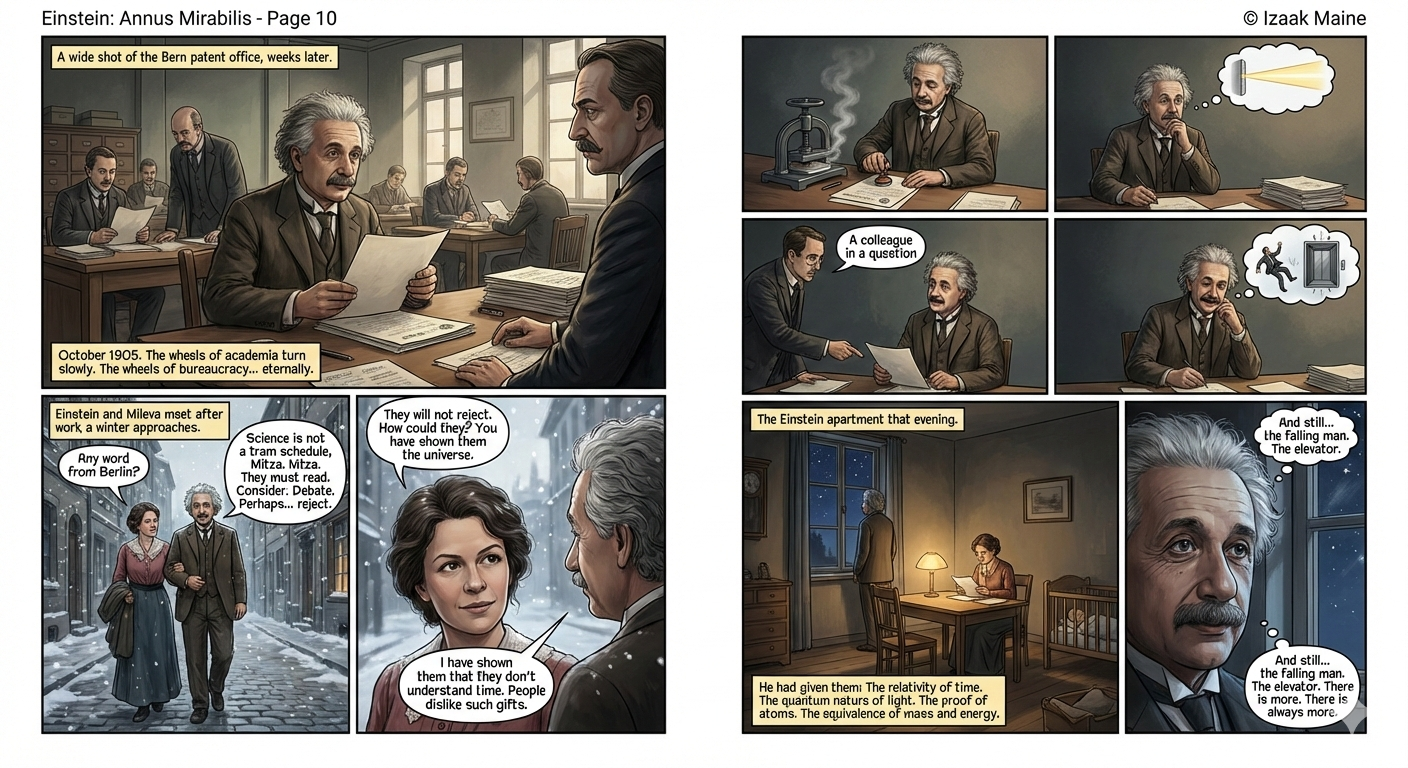
Albert Einstein was 26 years old, earning 3,500 francs a year, and living in a modest apartment with his wife Mileva and their infant son Hans Albert. By day, he evaluated other people’s inventions. By night, and during what he cheerfully called his “theoretical physics department” hours at work, he was quietly dismantling every assumption about reality that had stood since Newton.
The patents, as it happened, were perfect training. “I was able to do a full day’s work in only two or three hours,” Einstein later recalled with characteristic insouciance. “The remaining part of the day, I would work out my own ideas.” One imagines his supervisor would have been less than thrilled had he known his junior examiner was moonlighting as a revolutionary.
The question that haunted Einstein was deceptively simple, the kind that occurs to bright teenagers and obsessive physicists: What would happen if you could ride alongside a beam of light? He’d been chewing on this since he was 16, and it had become something of a magnificent obsession. The problem was that James Clerk Maxwell’s equations said light speed was constant—always 186,282 miles per second, regardless of the observer’s motion. Which meant, impossibly, that even if you were traveling at 99 percent the speed of light, a light beam would still race past you at full speed.
Something had to give. For a decade, Einstein worried at this paradox like a dog with a particularly stubborn bone.
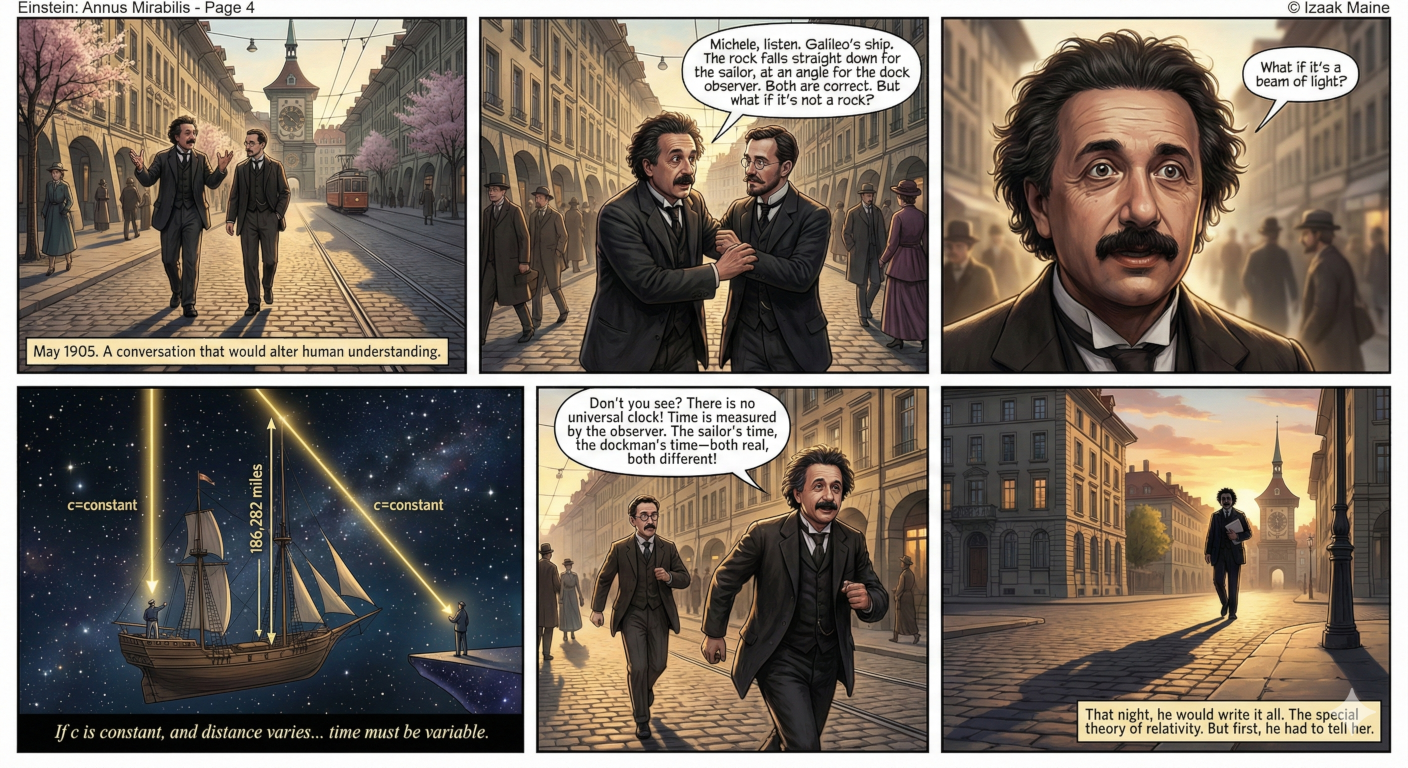
Then came that walk home in May 1905.
Michele Besso, Einstein’s closest friend and fellow patent clerk, had the dubious honor of being Einstein’s sounding board that evening. Picture two men in modest suits walking the cobblestone streets of Bern as one of them casually proposes to overturn several millennia of human understanding. Einstein posed his thought experiment: imagine Galileo’s famous ship, but instead of dropping a rock from the mast, you send down a beam of light while the ship is moving.
For the sailor on the ship, the light falls straight down. For someone on the dock, it travels at an angle—a longer distance. But the speed is the same for both observers. Einstein stopped walking. If the distance changes but the speed doesn’t…
“Then TIME must change!”
One can only imagine Besso’s expression.
Einstein reportedly spent that night in a fever of calculation, covering every available surface in his apartment with equations while Mileva brought coffee and quietly marveled—or worried—at what her husband had unleashed. By dawn, he had rewritten physics.
Time, Einstein realized, was not the cosmic metronome everyone had assumed. It was elastic, relative, dependent on motion. Two events that appeared simultaneous to one observer might occur at different times for another observer moving at a different speed. The universe, it turned out, had no master clock.
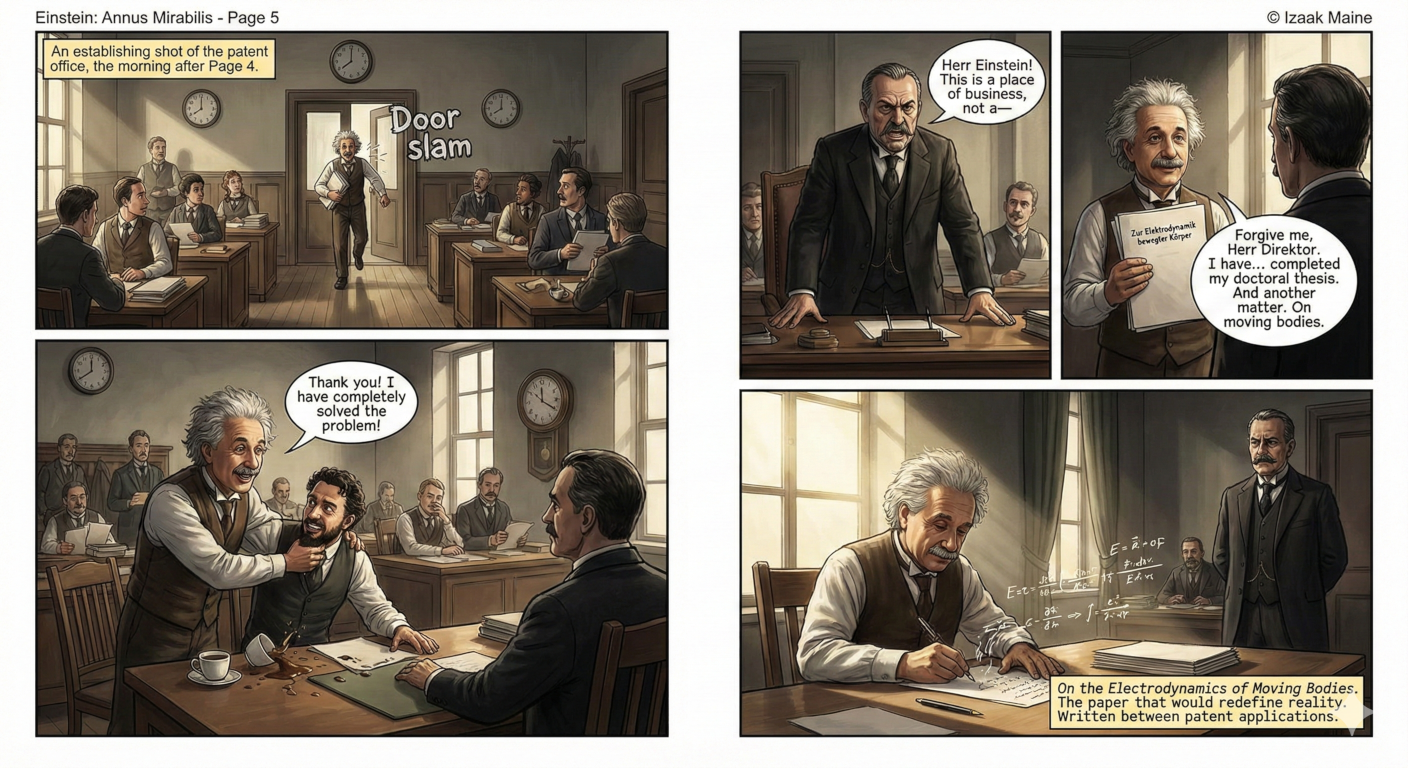
“Thank you!” Einstein greeted Besso the next morning at the patent office. “I have completely solved the problem.”
This was not the greeting one typically received from a civil servant at 8 a.m., but Besso was apparently used to it.
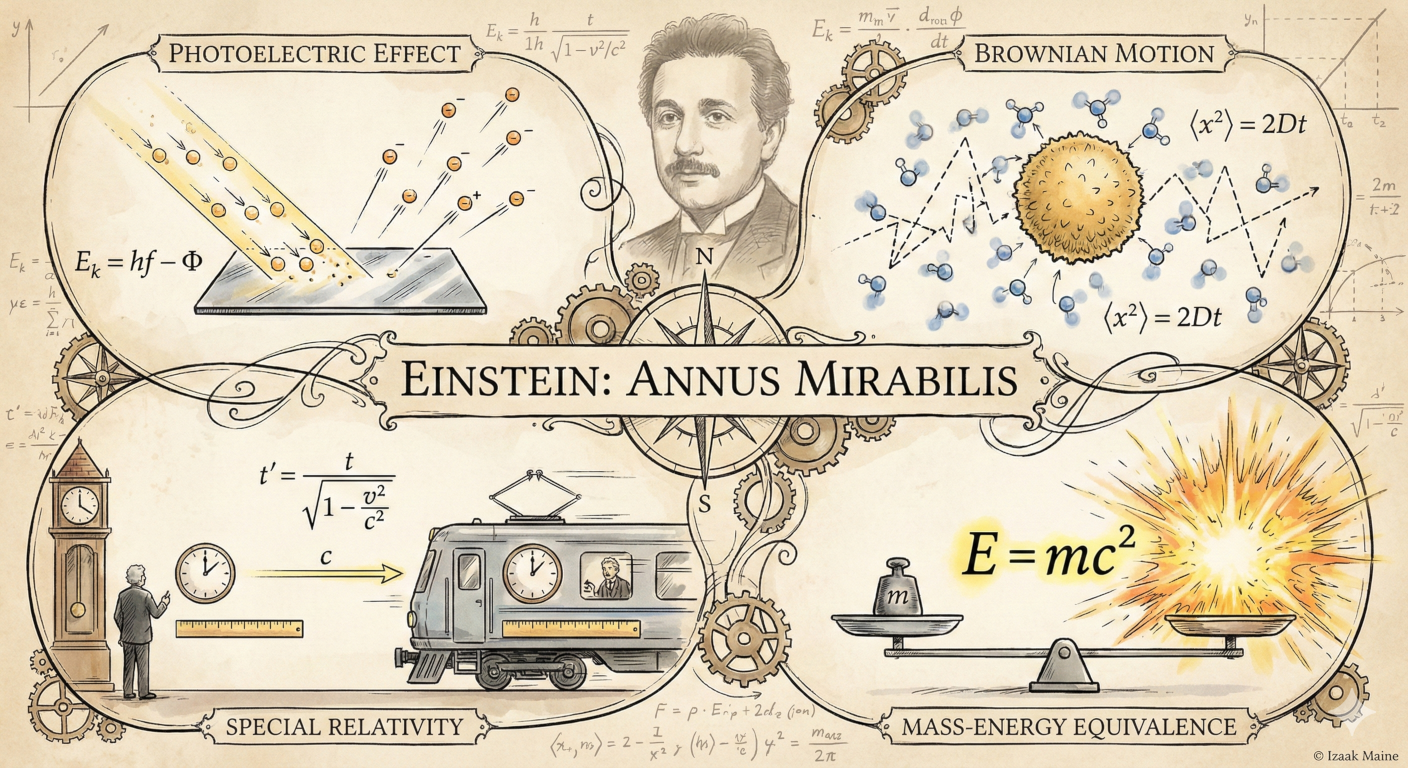
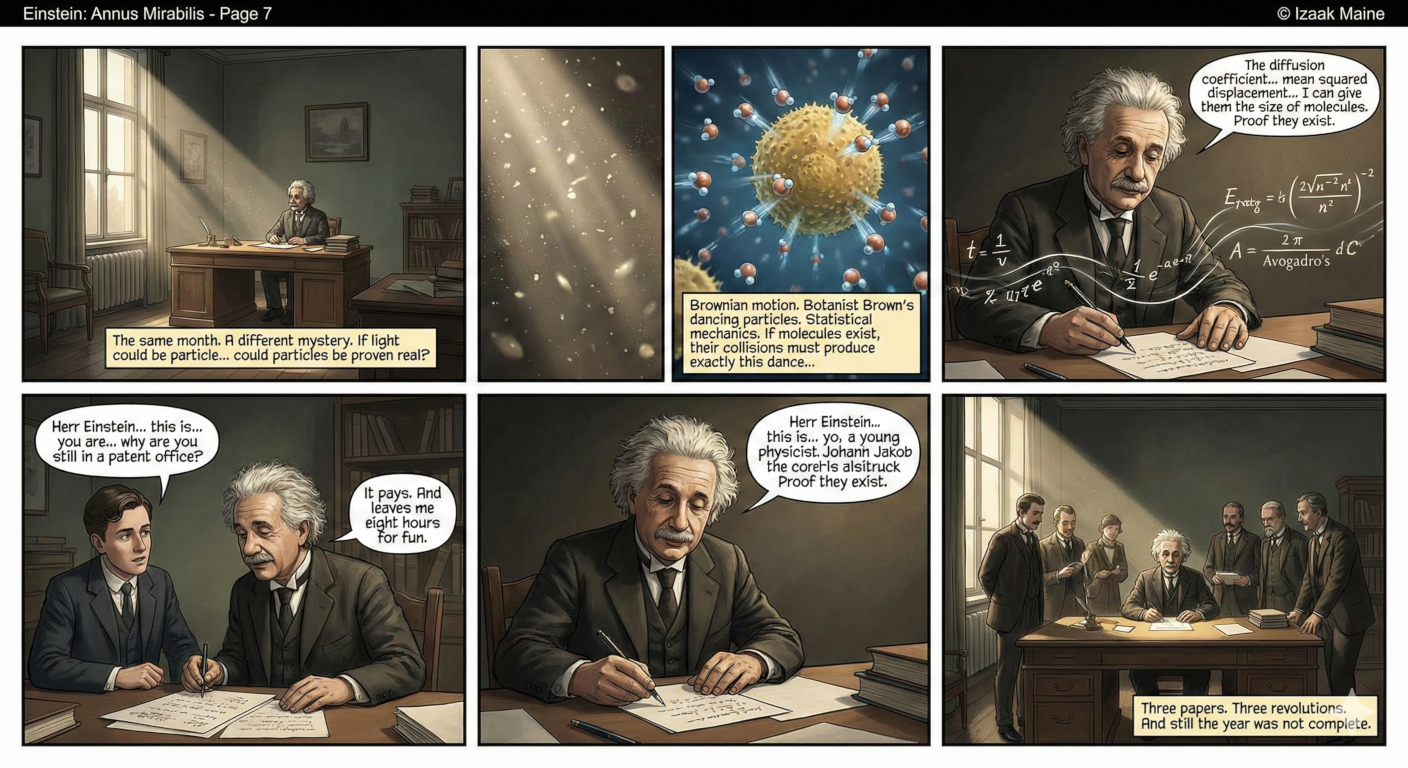
What followed was perhaps the most productive four months in the history of science. Between March and June 1905, Einstein produced four papers that would revolutionize physics. The first explained how to measure molecular size in liquids. The second demonstrated Brownian motion—the erratic dance of particles suspended in fluid—thereby proving atoms actually existed (a point still contested by some physicists at the time, which seems charmingly quaint in retrospect).
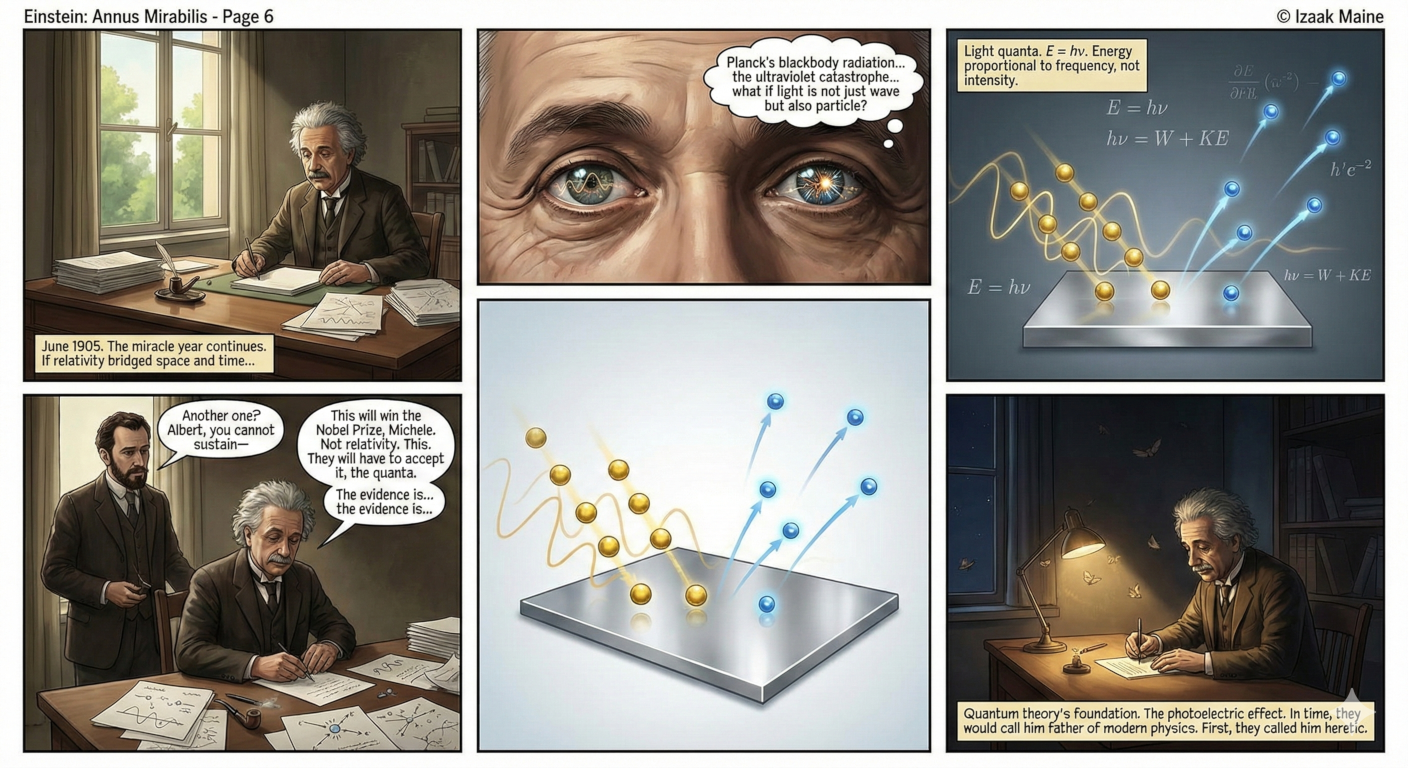
The third paper was almost an aside: light, Einstein proposed, comes in discrete packets he called quanta—later known as photons. This was the foundation of quantum physics, though Einstein would spend the rest of his life uncomfortable with where that particular road led. “God does not play dice,” he would later protest, to which Niels Bohr supposedly replied, “Stop telling God what to do.”
The fourth paper, submitted in June, was special relativity. Space and time, Einstein argued, were not separate entities but a unified fabric—spacetime—that bent and warped depending on motion. Simultaneity itself was relative. There was no universal “now.”
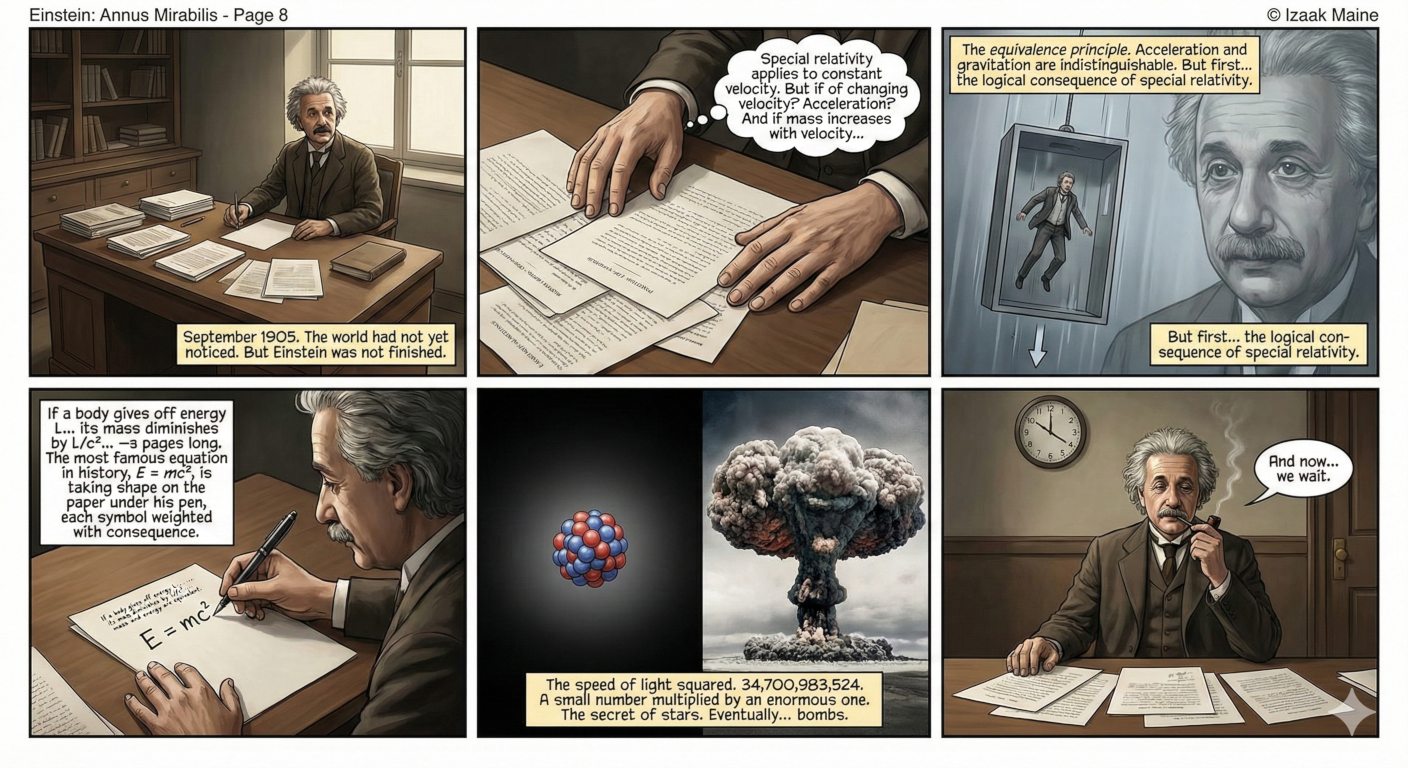
Then, in September, almost as an afterthought, came the coda: a brief paper pointing out that his equations implied something extraordinary. Matter and energy were interchangeable. Specifically, energy equals mass times the speed of light squared. E=mc².
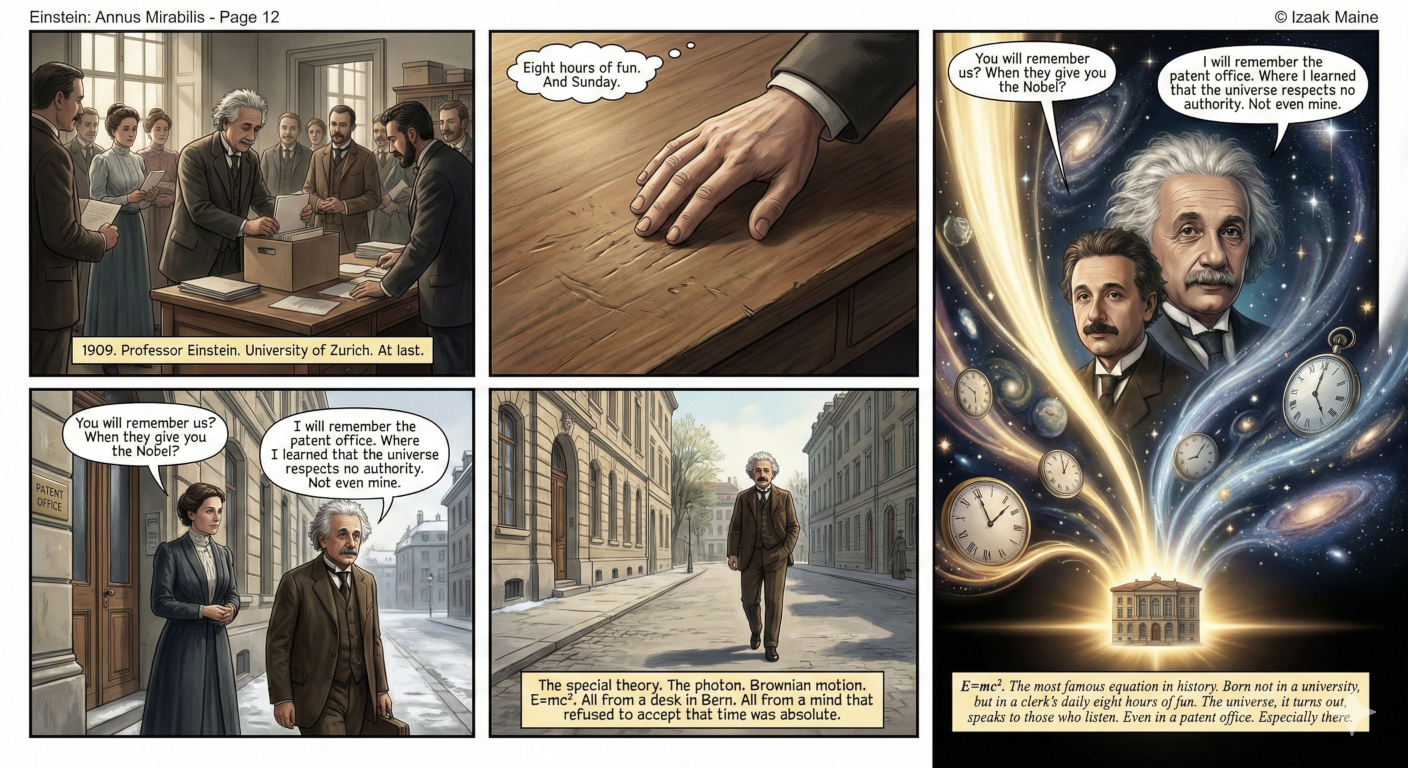
It was the most famous equation in history, derived by a patent clerk in his spare time.
The delicious irony of Einstein’s situation was not lost on him. Here was a man who couldn’t secure an academic position—who had been rejected for teaching jobs and had settled for government work—remaking the foundations of science from a third-floor office while evaluating patents for electrical devices. It’s rather like learning that Darwin worked out evolution while employed at a zoo gift shop, or that Beethoven composed symphonies between shifts at a piano factory.
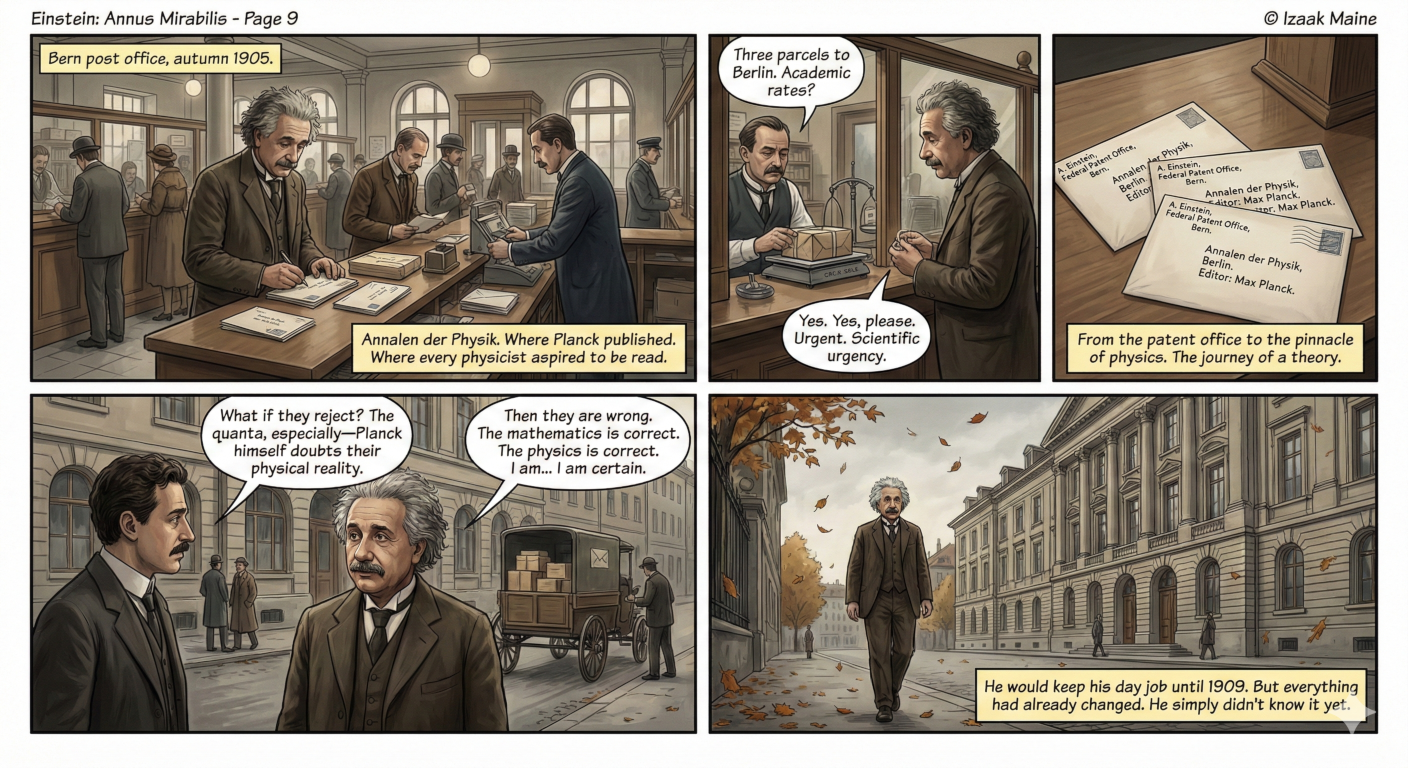
The papers were submitted to Annalen der Physik, where they appeared with minimal fanfare. Einstein returned to examining patents, presumably with a slight smile. He had no idea that within a decade he would be the most famous scientist since Newton, or that his equation would underpin both nuclear power and nuclear weapons, or that general relativity—which he was already contemplating—would predict black holes and the Big Bang.
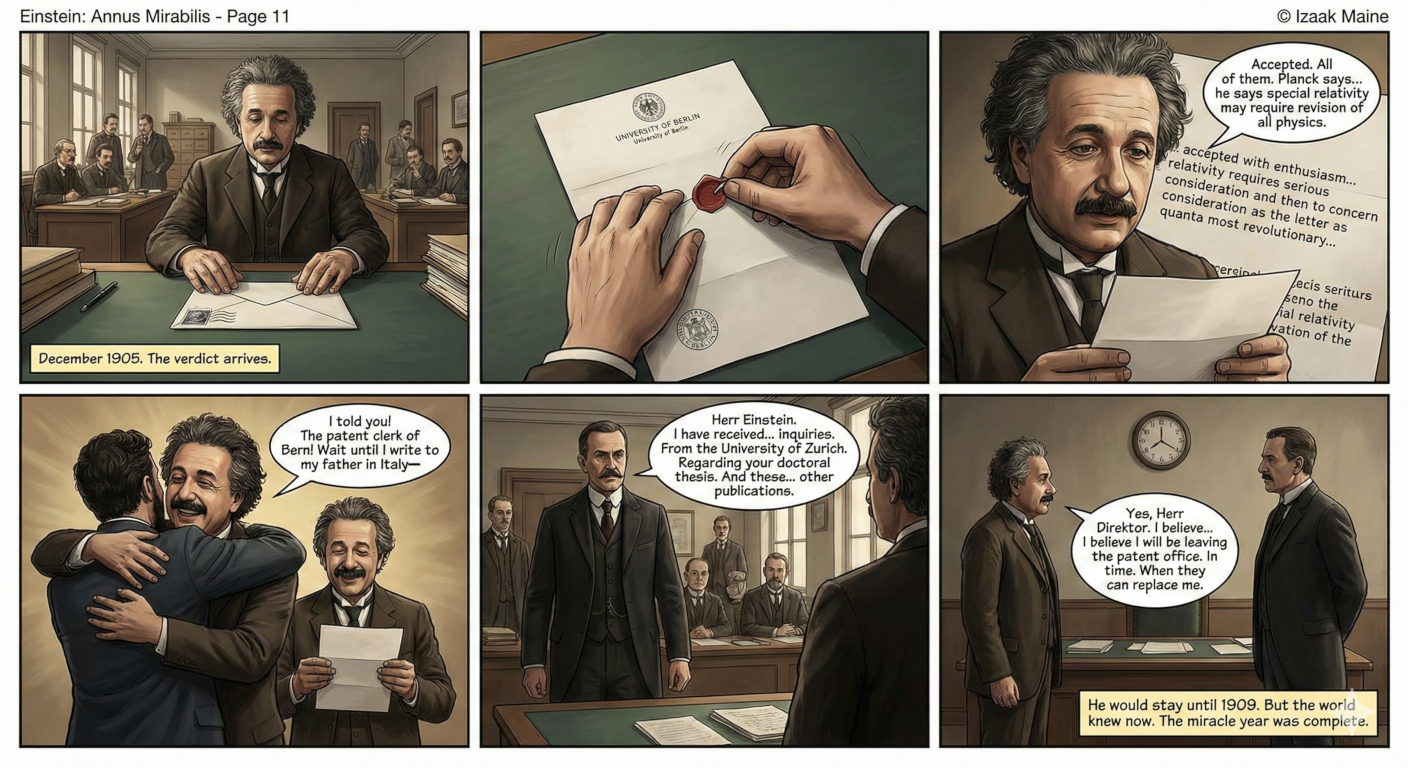
Recognition came slowly, then suddenly. Max Planck noticed. The physics community began to grasp what this patent clerk had done. By 1908, Einstein was lecturing at the University of Bern, though he kept his day job for a while longer. One suspects he found a certain satisfaction in that.
What Einstein accomplished in 1905 was more than scientific achievement—it was a triumph of imagination over assumption. For thousands of years, humans had assumed time was absolute because it felt absolute. Einstein dared to ask: what if we’re wrong? That willingness to question the obvious, to trust mathematics over intuition, to ride thought experiments into the unknown—that was his genius.
The patent office still stands on Speichergasse, now a UNESCO World Heritage site. Tourists photograph the building where Einstein worked, though it looks unremarkable—just another handsome Swiss government edifice. Which is perhaps fitting. The most revolutionary ideas in modern physics were born not in an ivory tower but in a bureaucrat’s office, squeezed between evaluations of electromagnetic regulators, by a young man with wild dreams and time to kill.
Sometimes the universe reveals its secrets to those patient—or stubborn—enough to keep asking the right questions. Even if you’re supposed to be working.
Reference: Medium