The Queen Who Crossed Deserts For Wisdom
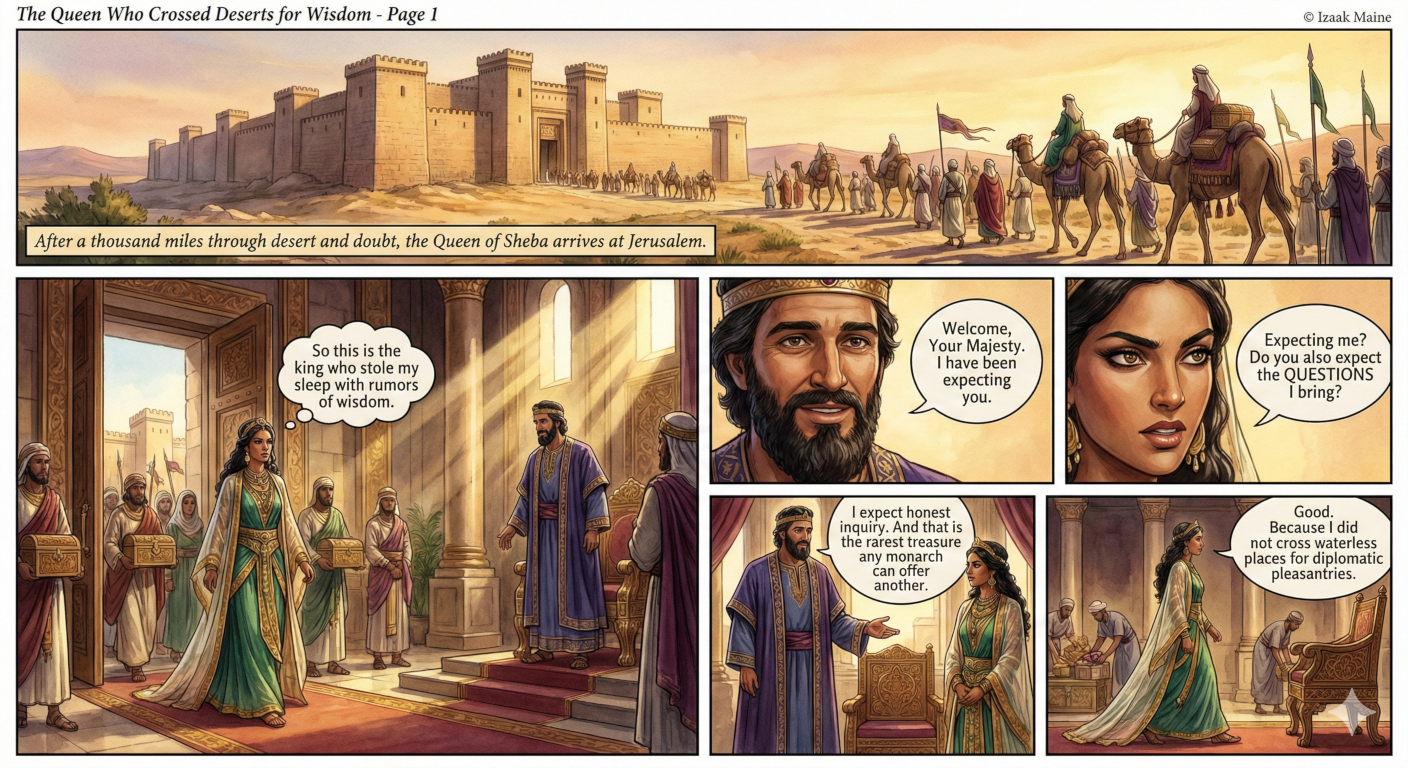
The marble halls of Solomon’s palace gleamed in the afternoon light, casting geometric shadows across floors inlaid with precious stones. The Queen of Sheba stood at the threshold, her entourage stretching behind her like a river of silk and spices. She had traveled over a thousand miles for this moment, and now, face to face with the king whose reputation had haunted her thoughts for months, she felt something unexpected: not intimidation, but acceleration. Her mind quickened.
Solomon rose from his throne, his eyes calm as deep water. “Welcome, Your Majesty. I have been expecting you.”
“Expecting me?” The Queen’s voice carried the musicality of her homeland, edged with challenge. “Do you also expect the questions I bring?”
“I expect honest inquiry,” Solomon replied, gesturing toward a seat prepared beside his own. “And that is the rarest treasure any monarch can offer another.”
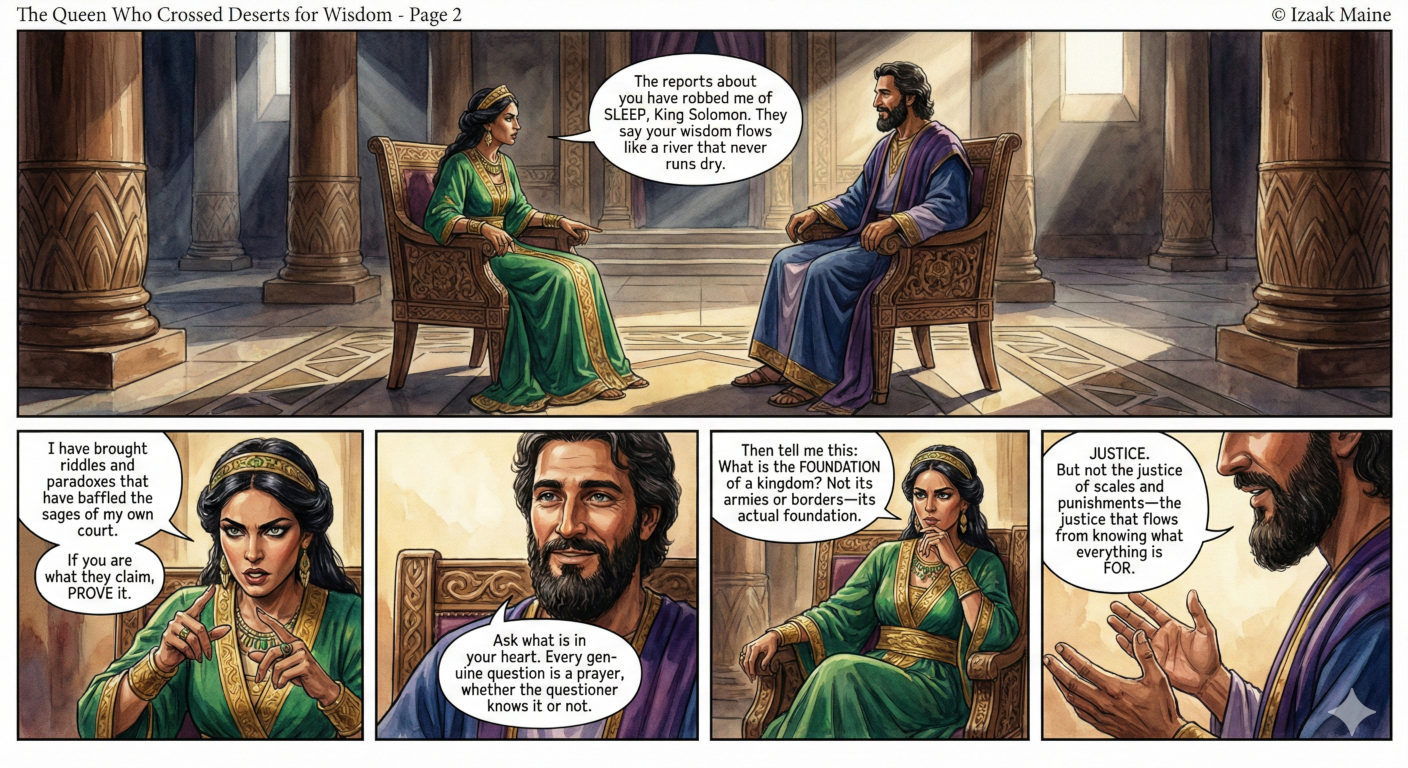
She studied him as she approached—not with the suspicion of a rival, but with the intensity of a seeker. “Let me be direct, King Solomon. I did not journey through waterless places to exchange diplomatic pleasantries. I came because the reports about you have robbed me of sleep. They say your wisdom flows like a river that never runs dry. They say you speak with the voice of the Eternal. I have brought riddles, paradoxes, and questions that have baffled the sages of my own court. If you are what they claim, prove it. If you are merely clever, I will know.”
Solomon’s expression warmed. “Ask what is in your heart. Every genuine question is a prayer, whether the questioner knows it or not.”
The Queen settled into her seat, but there was nothing settled about her posture. She leaned forward, alive with purpose. “Then tell me this: What is the foundation of a kingdom? Not its armies or its borders—its actual foundation. The thing beneath everything else.”
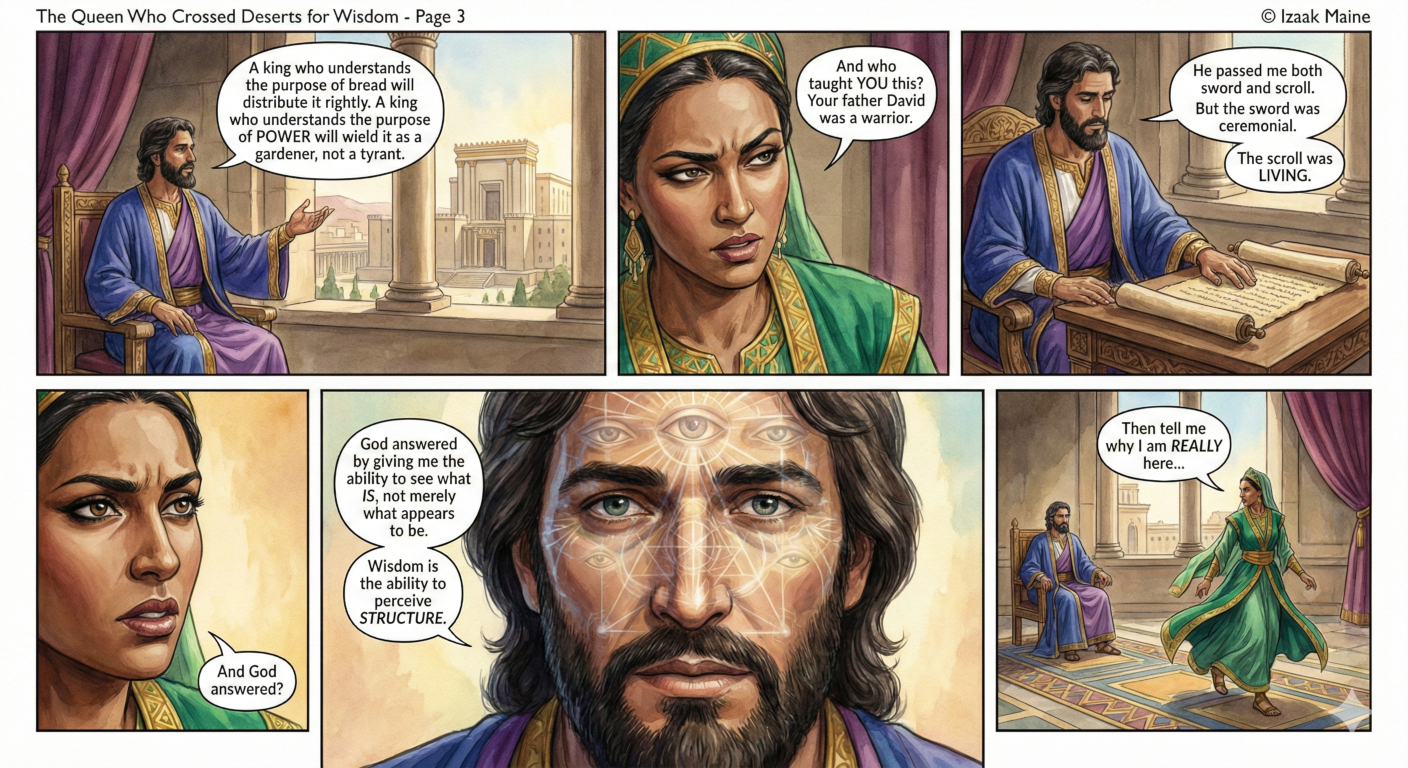
“Justice,” Solomon answered without hesitation. “But not the justice of scales and punishments. The justice that flows from knowing what everything is for. A king who understands the purpose of bread will distribute it rightly. A king who understands the purpose of power will wield it as a gardener, not a tyrant. Justice is wisdom applied to relationships—between ruler and people, between law and mercy, between heaven and earth.”
The Queen’s eyes narrowed thoughtfully. “And who taught you this? Your father David was a warrior. Did he pass you a sword or a scroll?”
“Both,” Solomon said. “But the sword was ceremonial. The scroll was living. My father taught me that a king’s greatest weapon is not the one he carries, but the One he worships. He told me that wisdom is not native to the human heart. It must be asked for. So I asked.”
“And God answered?”
“God answered by giving me the ability to see what is, not merely what appears to be. Most people mistake information for wisdom. They collect facts like shells on a beach, admiring their surfaces. But wisdom is the ability to perceive structure—to see how things connect, why they break, what they’re becoming. God gave me eyes to see the anatomy of truth.”
The Queen stood suddenly and began to pace, her robes whispering across the floor. “Then tell me why I am here. Not the official reason—the real reason. I told my court I came to verify reports. I told myself I came to test you. But standing in your presence now, I feel something else. What am I truly seeking?”
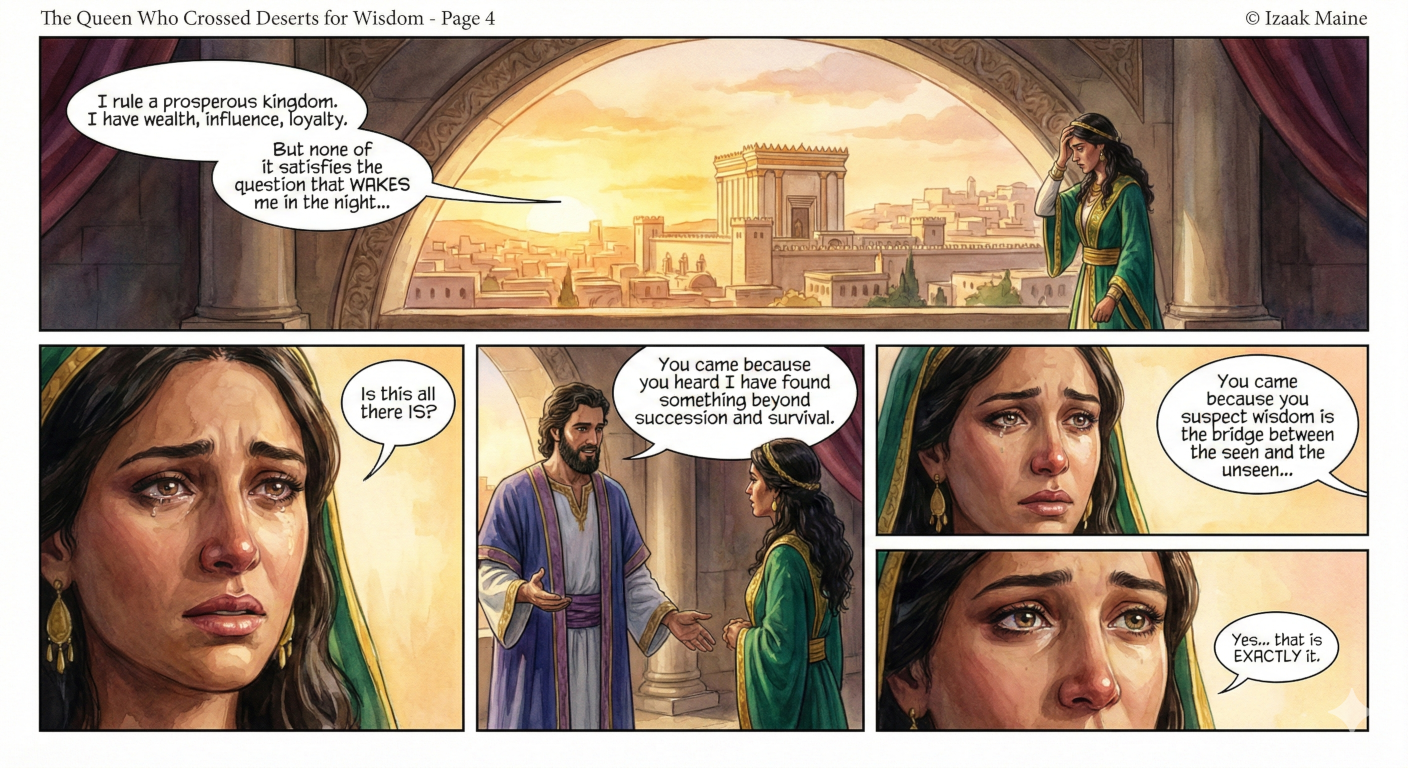
Solomon watched her with compassion. “You are seeking confirmation that the hunger inside you is not madness. You rule a prosperous kingdom. You have wealth, influence, the loyalty of your people. But none of it satisfies the question that wakes you in the night: Is this all there is? You came here because you heard that I have found something beyond succession and survival. You came because you suspect that wisdom is the bridge between the seen and the unseen, and you want to cross it.”
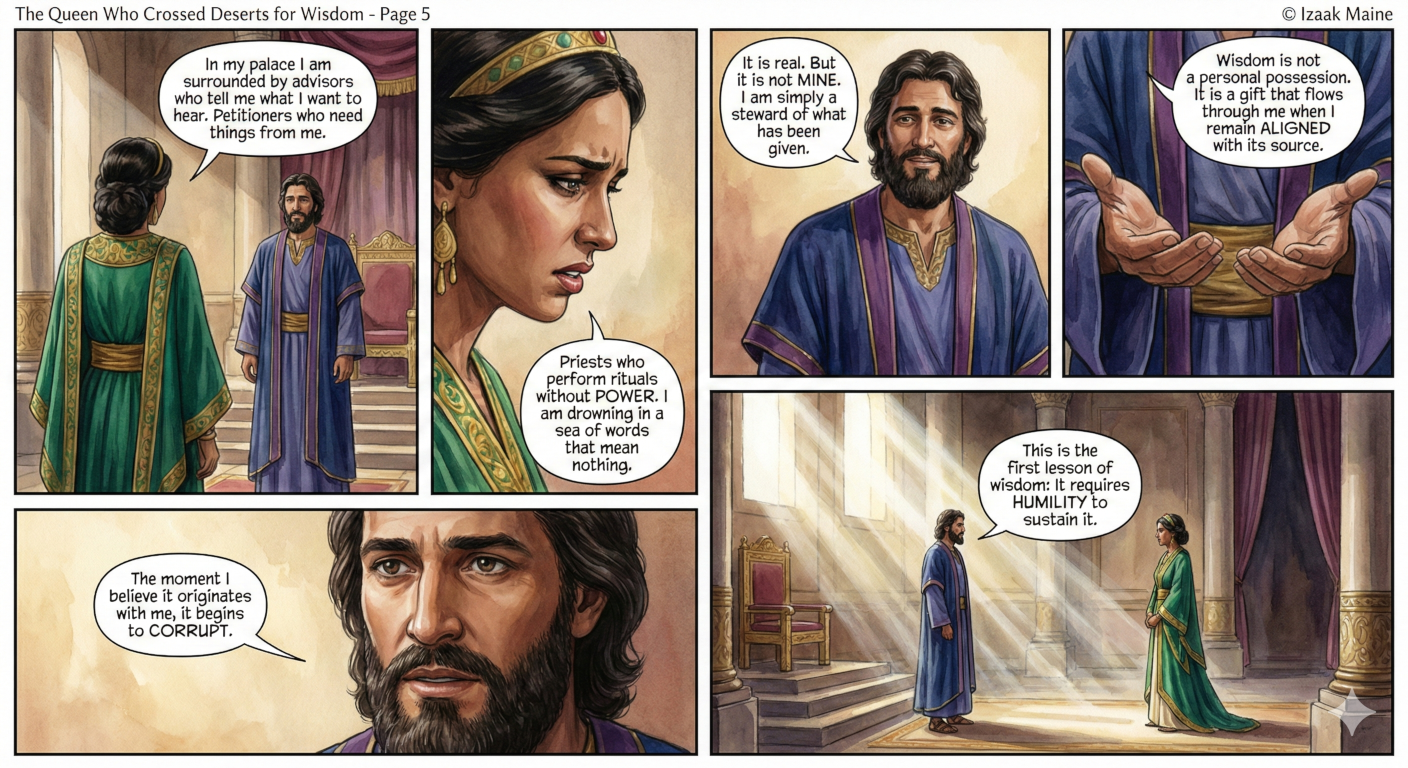
The Queen stopped pacing. Her composure cracked just enough to reveal the woman beneath the crown. “Yes,” she whispered. “Yes, that is exactly it. In my palace, I am surrounded by advisors who tell me what I want to hear. Petitioners who need things from me. Priests who perform rituals without power. I am drowning in a sea of words that mean nothing. Then I heard about you—a king who speaks and things change. Not by force, but by truth. I had to know if such a thing was real.”
“It is real,” Solomon said gently. “But it is not mine. I am simply a steward of what has been given. The wisdom you sense is not a personal possession. It is a gift that flows through me when I remain aligned with its Source. The moment I believe it originates with me, it begins to corrupt. This is the first lesson of wisdom: it requires humility to sustain it.”
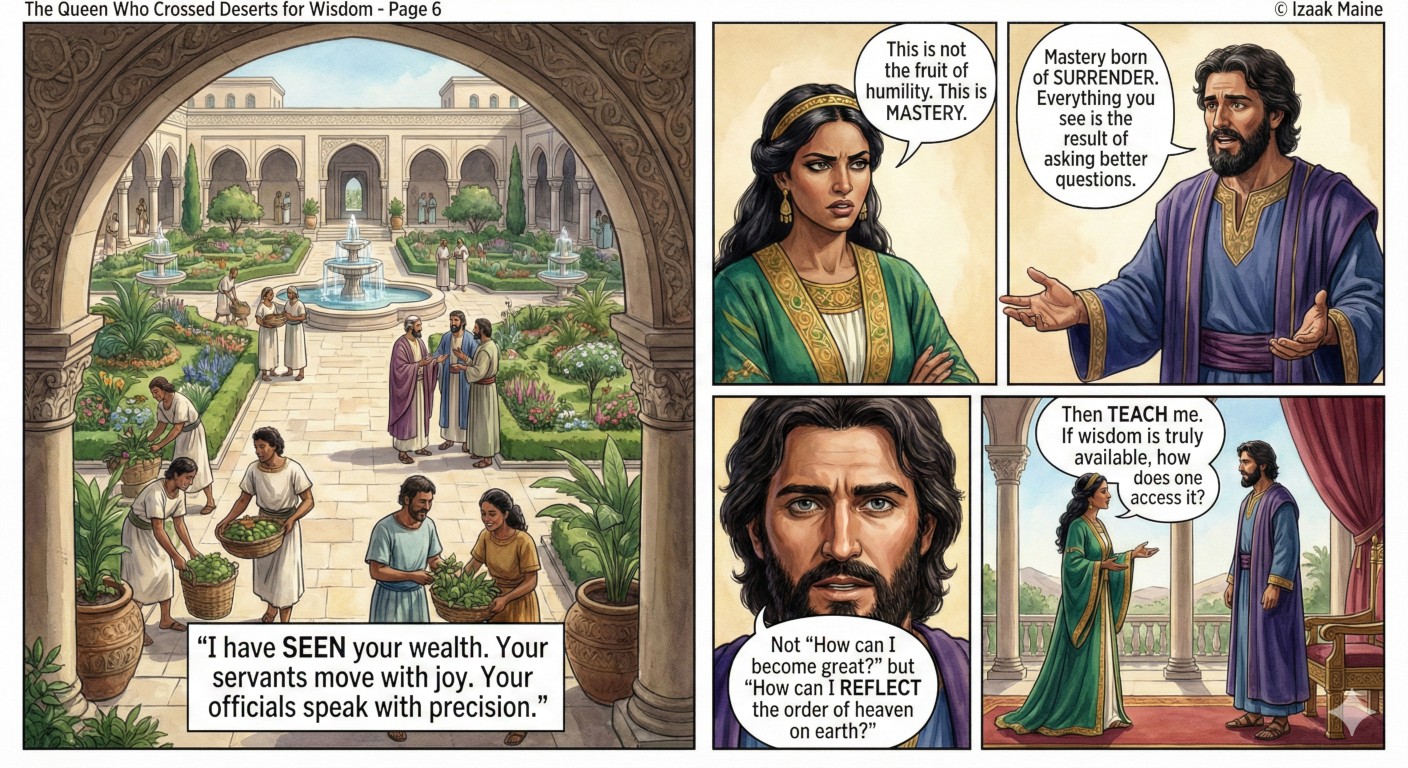
“Humility?” The Queen’s tone sharpened again. “I have seen your wealth. Your kingdom is a wonder. The reports did not exaggerate—they understated. Your servants move with joy. Your officials speak with precision. Even the food at your table is arranged with intentionality. This is not the fruit of humility. This is mastery.”
“Mastery born of surrender,” Solomon countered. “Everything you see is the result of asking better questions. Not ‘How can I become great?’ but ‘How can I reflect the order of heaven on earth?’ Not ‘How can I be served?’ but ‘How can I serve what is truly valuable?’ When you stop building monuments to yourself, you become available to build something eternal. This palace, this administration, this peace—it is all the overflow of alignment. I do not create it. I cooperate with it.”
The Queen returned to her seat, but her eyes were ablaze now. “Then teach me. If wisdom is truly available, how does one access it? I have consulted oracles. I have studied the stars. I have fasted and made sacrifices. What am I missing?”
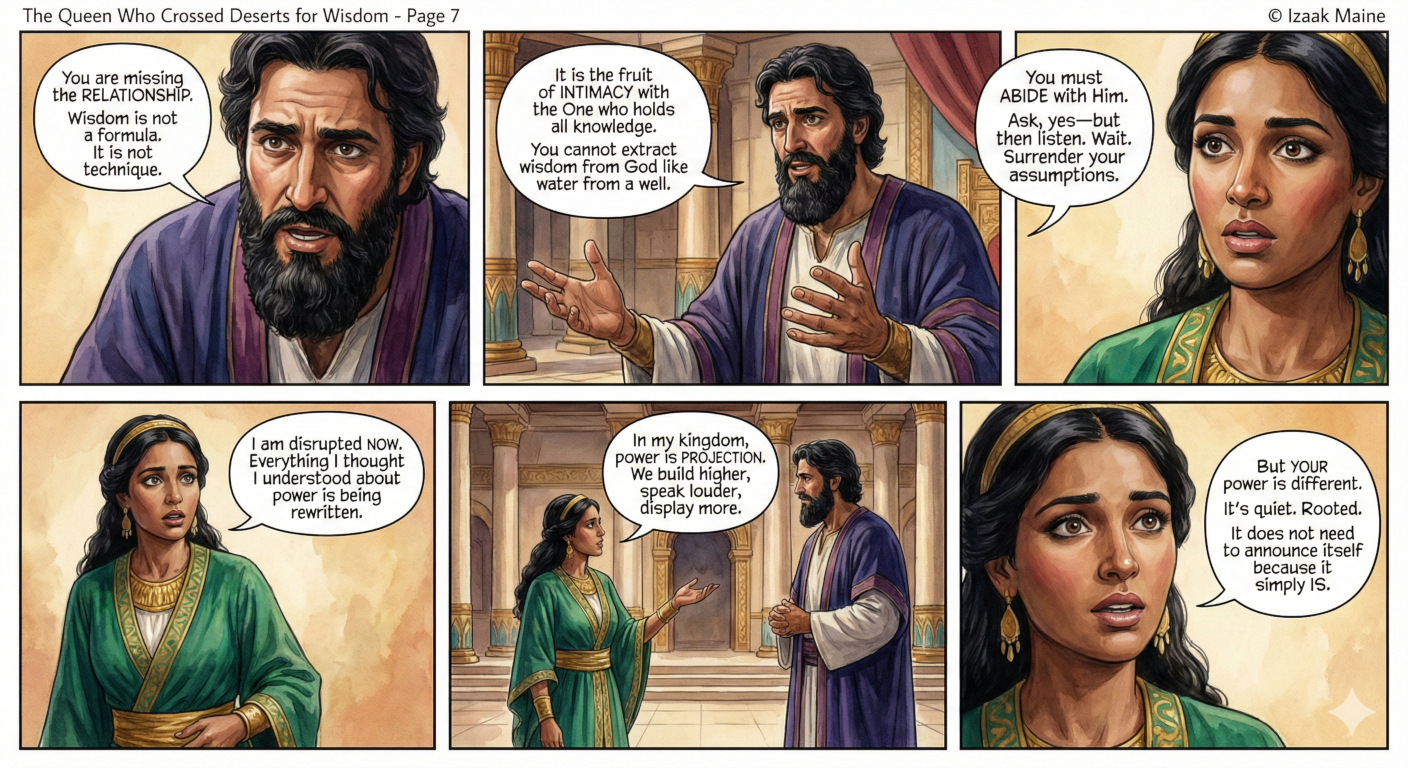
Solomon leaned forward, his voice low and urgent. “You are missing the relationship. Wisdom is not a formula. It is not technique. It is the fruit of intimacy with the One who holds all knowledge. You cannot extract wisdom from God like water from a well. You must abide with Him. Ask, yes—but then listen. Wait. Surrender your assumptions. Wisdom often arrives as a disruption to what you thought you knew.”
“I am disrupted now,” the Queen admitted. “Everything I thought I understood about power is being rewritten in my mind as we speak. In my kingdom, power is projection. We build higher, speak louder, display more. But your power is different. It’s quiet. Rooted. It does not need to announce itself because it simply is. How did you cultivate this?”
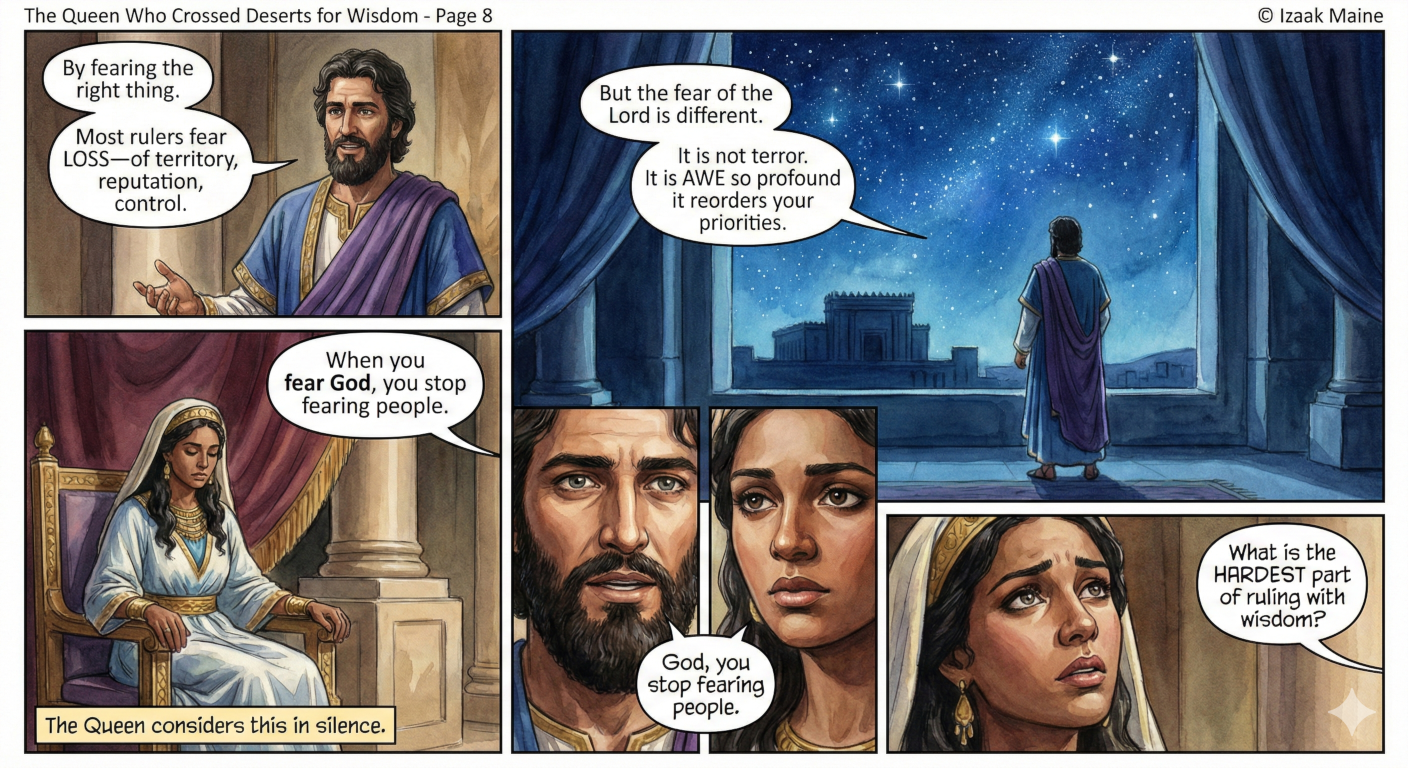
“By fearing the right thing,” Solomon said. “Most rulers fear loss—of territory, of reputation, of control. But the fear of the Lord is different. It is not terror. It is awe so profound it reorders your priorities. When you fear God, you stop fearing people. When you revere what is eternal, temporary things lose their tyranny over you. This fear is the beginning of wisdom because it puts you in your proper place—not as the center of the universe, but as a participant in something far greater.”
The Queen was silent for a long moment, absorbing this. Then she asked, “What is the hardest part of ruling with wisdom?”
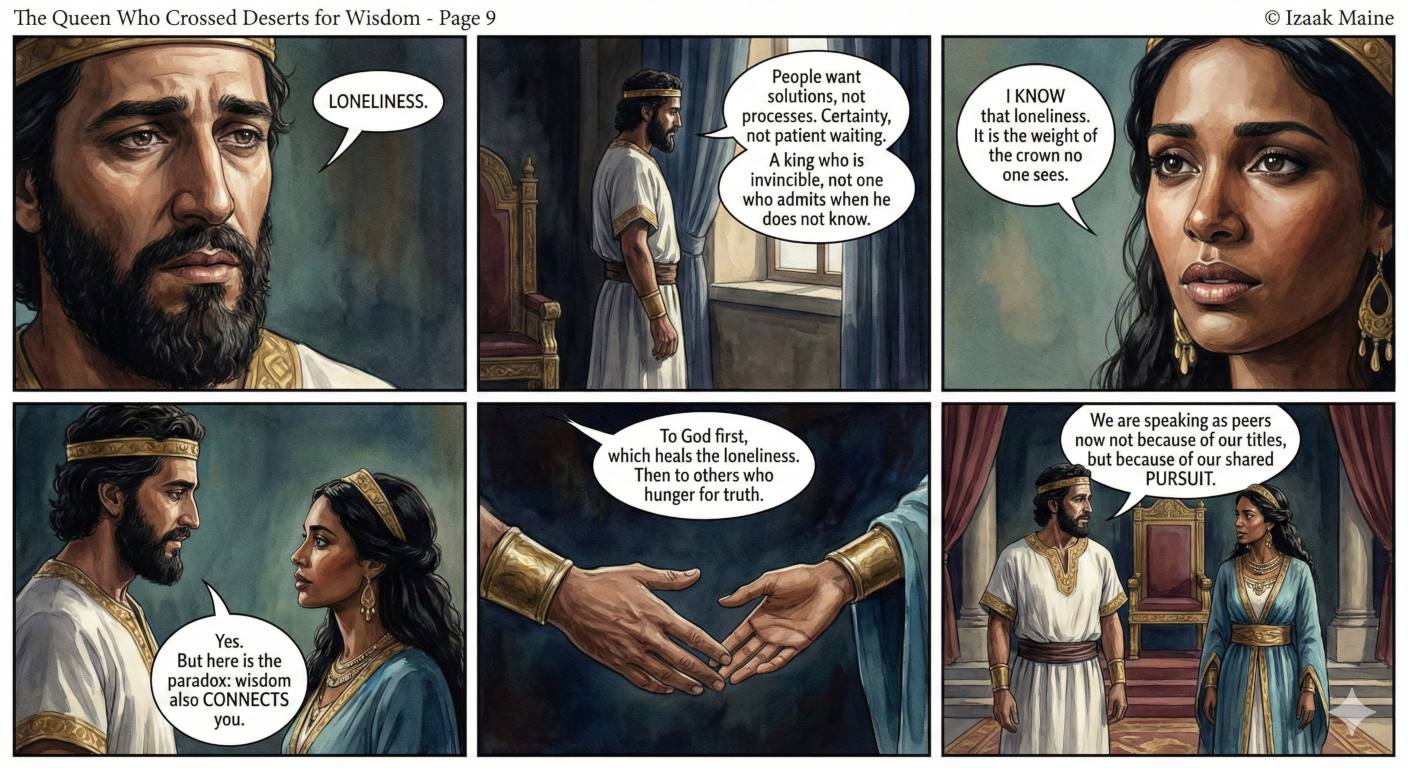
“Loneliness,” Solomon answered immediately. “People want solutions, not processes. They want certainty, not the patient waiting that wisdom often requires. They want a king who is invincible, not one who admits when he does not know. Wisdom isolates you because it demands you see what others refuse to see. You must speak truths that are inconvenient. You must choose what is right over what is popular. And you must do it knowing that even those you love may not understand.”
“I know that loneliness,” the Queen said softly. “It is the weight of the crown no one sees.”
“Yes,” Solomon agreed. “But here is the paradox: wisdom also connects you. To God first, which heals the loneliness. Then to others who hunger for truth. You and I are speaking as peers now not because of our titles, but because of our shared pursuit. Wisdom creates a fellowship that transcends borders.”
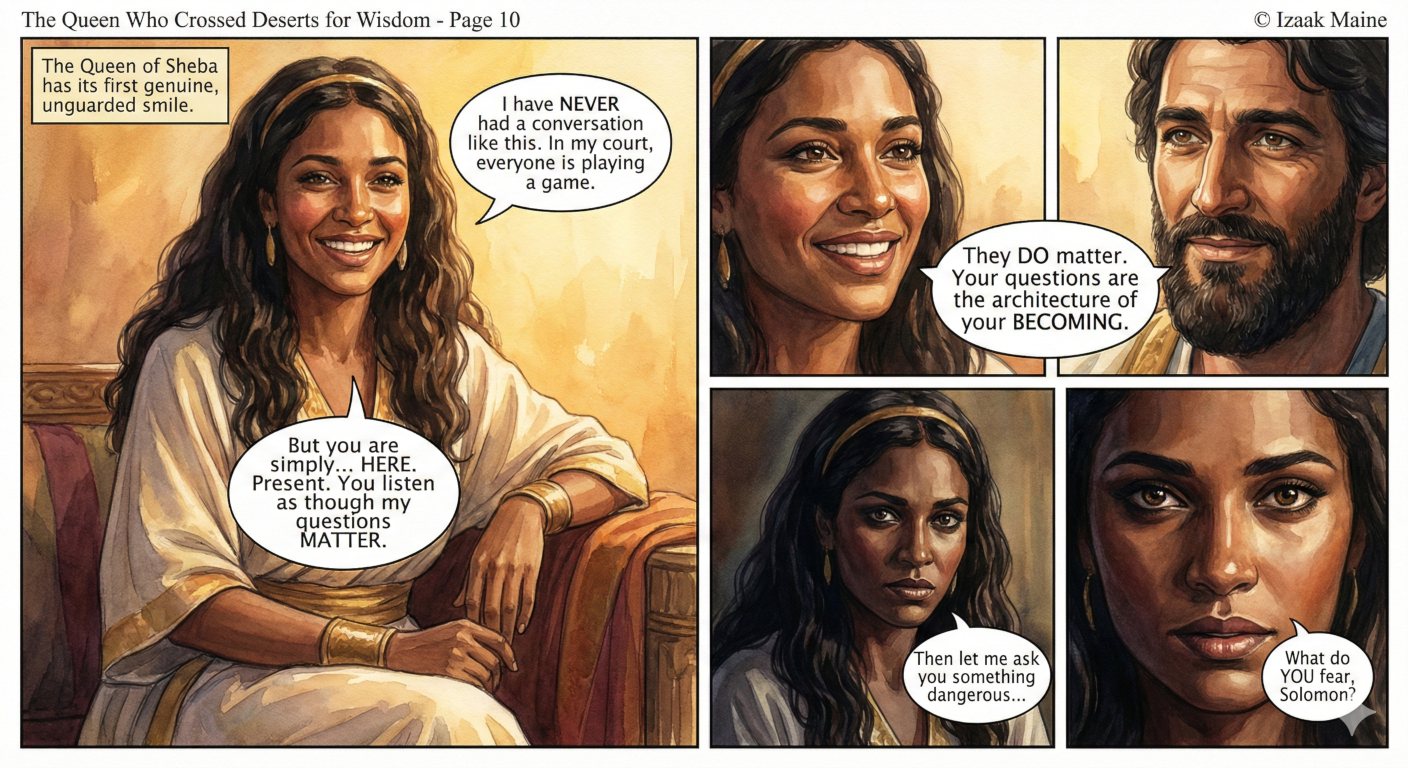
The Queen smiled for the first time—a real smile, unguarded. “I have never had a conversation like this. In my court, everyone is playing a game. Maneuvering. Calculating. But you are simply…here. Present. You listen as though my questions matter.”
“They do matter,” Solomon said. “Your questions are the architecture of your becoming. Every inquiry you bring is shaping you into someone new. This is why I never dismiss a seeker. God Himself honors those who search.”
“Then let me ask you something dangerous,” the Queen said, her voice dropping. “What do you fear? You have everything—wisdom, wealth, peace, the favor of God. What keeps you awake at night?”
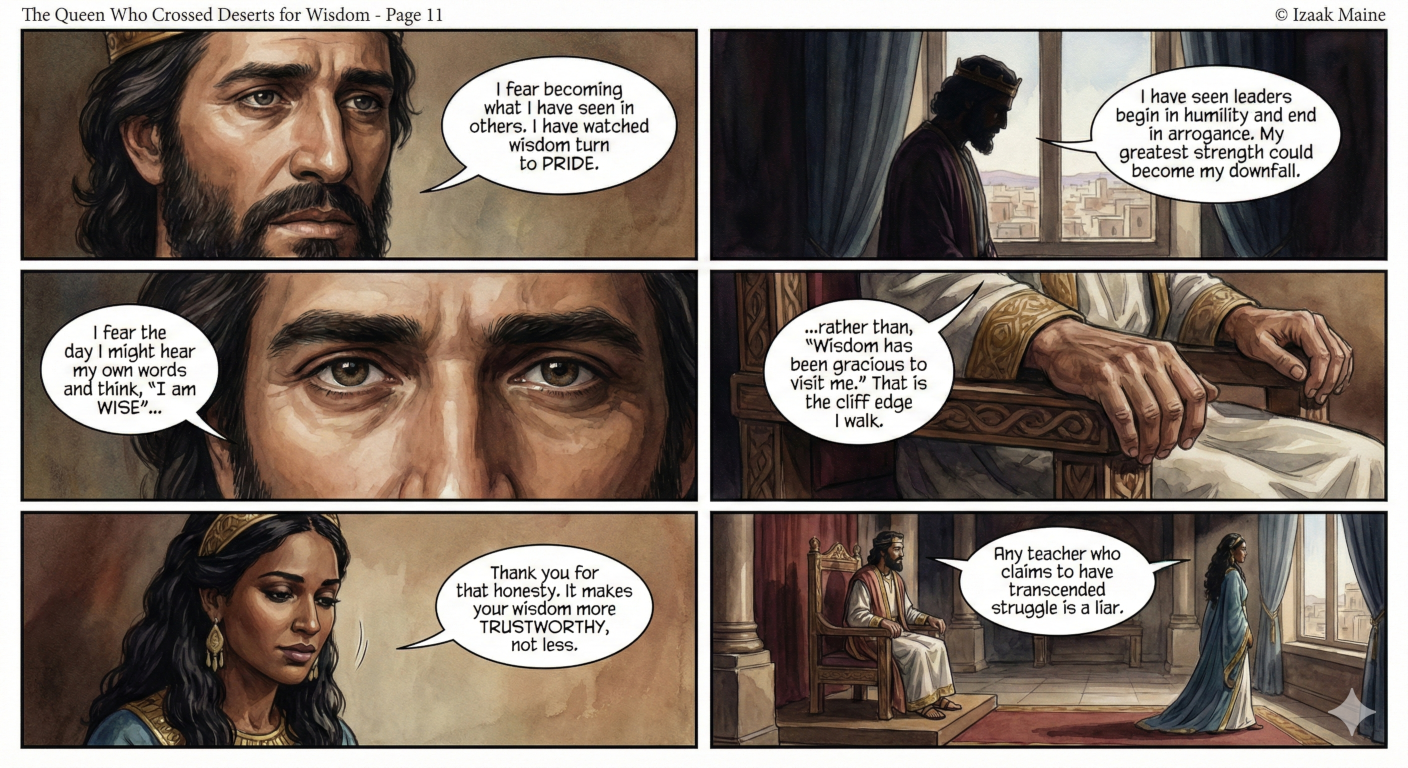
Solomon’s expression grew somber. “I fear becoming what I have seen in others. I have watched wisdom turn to pride. I have seen leaders begin in humility and end in arrogance. I am aware that my greatest strength could become my downfall if I am not vigilant. So I fear the subtle drift—the slow forgetting of where this wisdom came from. I fear the day I might hear my own words and think, ‘I am wise,’ rather than, ‘Wisdom has been gracious to visit me.’ That is the cliff edge I walk.”
The Queen nodded slowly. “Thank you for that honesty. It makes your wisdom more trustworthy, not less. Any teacher who claims to have transcended struggle is a liar.”
“Or dangerously self-deceived,” Solomon added.
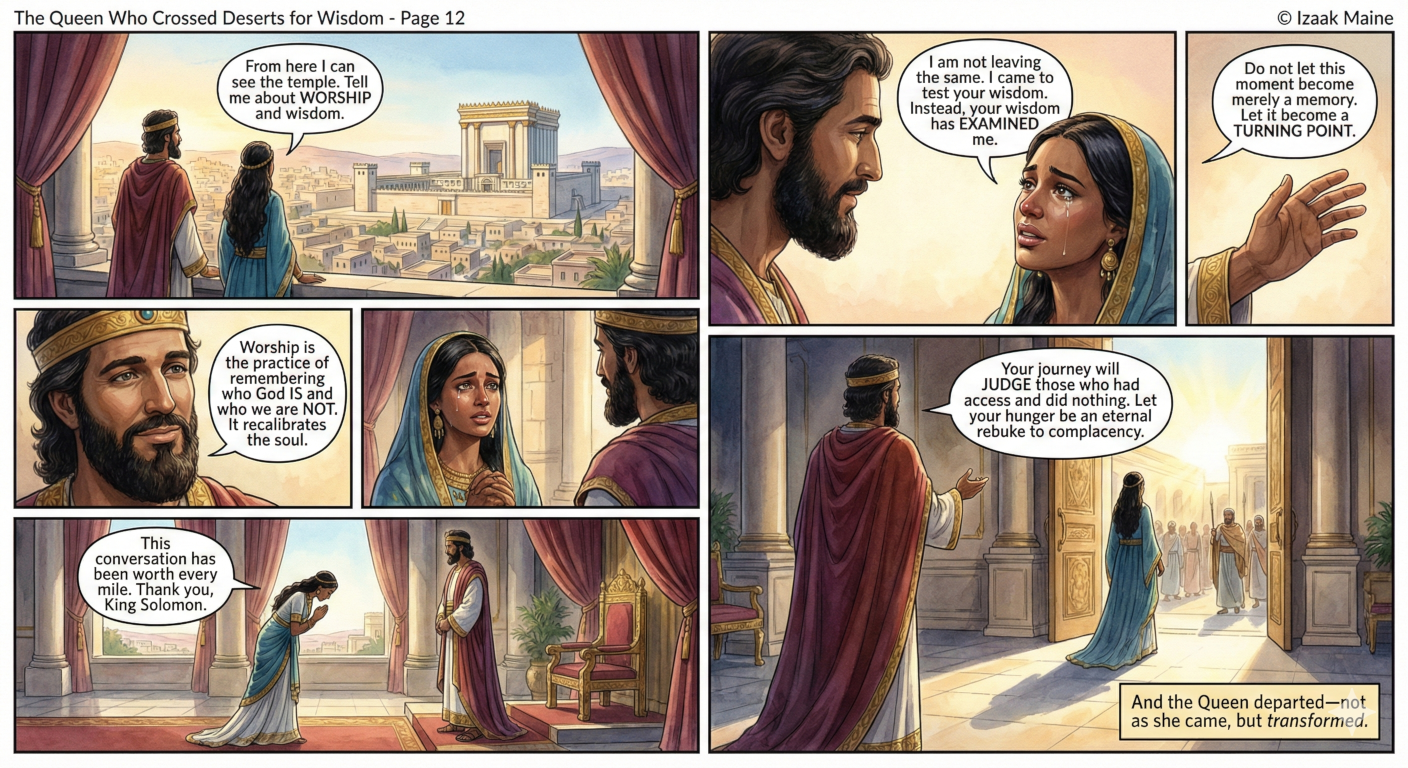
She rose again, but this time not to pace—to approach one of the great windows overlooking Jerusalem. “From here, I can see the temple. I watched the priests this morning. The precision of the rituals. The weight of the presence. Tell me about worship. How does it connect to wisdom?”
Solomon joined her at the window. “Worship is the practice of remembering who God is and who we are not. It recalibrates the soul. When I worship, I am not performing for God—I am realigning myself with reality. The temple you see is not a building where we manipulate the divine. It is a place where heaven touches earth, and we position ourselves to receive. Wisdom flows most freely in the posture of worship because worship empties us of the illusions that block perception.”
“We have temples in Sheba,” the Queen mused. “But I have never experienced what I felt this morning. It was as though the very air was conscious. Responsive. Alive.”
“That is because worship here is not about appeasing an absent deity,” Solomon explained. “It is about hosting a present God. The sacrifices, the songs, the structure—it all serves to create space for encounter. And when God shows up, everything changes. You do not leave the same.”
“I am not leaving the same,” the Queen said quietly. “I arrived with questions. I am leaving with more questions—but different ones. Better ones. I came to test your wisdom. Instead, your wisdom has examined me. It has shown me the poverty of my pursuits and the richness of what I neglected.”
Solomon turned to face her fully. “Then my counsel to you is this: Do not let this moment become merely a memory. Let it become a turning point. You have tasted something real. Now build your life around it. When you return to Sheba, do not return to business as usual. Let this encounter with wisdom—with the God who gives it—reshape your reign. Pursue Him as you pursued this audience. Ask Him the questions you asked me. And watch what He builds through a leader who would rather have truth than triumph.”
The Queen’s eyes glistened. “I brought you gifts—spices, gold, precious stones. Treasures of my kingdom. But I see now that I am leaving with something infinitely more valuable. I am leaving with a new understanding of what it means to rule. Not as a sovereign who demands submission, but as a servant who facilitates flourishing.”
“That is the inversion of heaven,” Solomon said. “Greatness is measured not by how many serve you, but by how well you serve what truly matters. And what truly matters is always connected to eternity.”
They stood together in silence, two rulers who had found common ground not in politics, but in the pursuit of something transcendent.
Finally, the Queen spoke once more. “Jesus—the prophet some speak of—they say He will be greater than you. That He will embody wisdom itself. Do you believe this?”
Solomon’s gaze grew distant, as though he could see across centuries. “I believe that everything I have been given is a shadow of something greater. If there is One coming who will be wisdom incarnate, then I am merely the announcement. The echo before the Voice. And I would gladly bow before that reality.”
The Queen of Sheba bowed her head. “Then I have truly been in the presence of greatness—not because of what you possess, but because of what you point toward. Thank you, King Solomon. This conversation has been worth every mile.”
As she turned to leave, Solomon called after her. “Your journey will judge those who had access and did nothing with it. You came from the ends of the earth for wisdom. Many sit within reach of truth and never move. Let your hunger be an eternal rebuke to complacency.”
She paused at the threshold, looking back one final time. “And let your witness be a lamp for all who lead. You have shown me that wisdom is not the possession of the brilliant, but the gift of the surrendered.”
And with that, the Queen of Sheba departed—not as she came, but transformed. She had traveled seeking answers. She left with something better: an awakened appetite for the God who holds them all.
Reference: The Queen Who Crossed Deserts For Wisdom